
Plan a corporate event menu for dietary restrictions by collecting guests’ exact requirements, confirming the caterer’s preparation limits, and documenting how each meal reaches the right person. Build appealing choices around those requirements, but never treat a menu label as proof that a dish is suitable for someone with a food allergy or celiac disease.
- Corporate event catering dietary restrictions require ingredient checks, preparation controls, and a clear serving plan—not menu labels alone.
- Gabbeys offers personalized menus and attentive service for corporate catering inquiries in Dallas and Fort Worth.
- Separate food allergies, medical dietary needs, religious requirements, and preferences before approving dishes.
- Confirm special-meal handling with the caterer before promising any guest that a meal meets their needs.
How do you plan a corporate event menu for dietary restrictions?
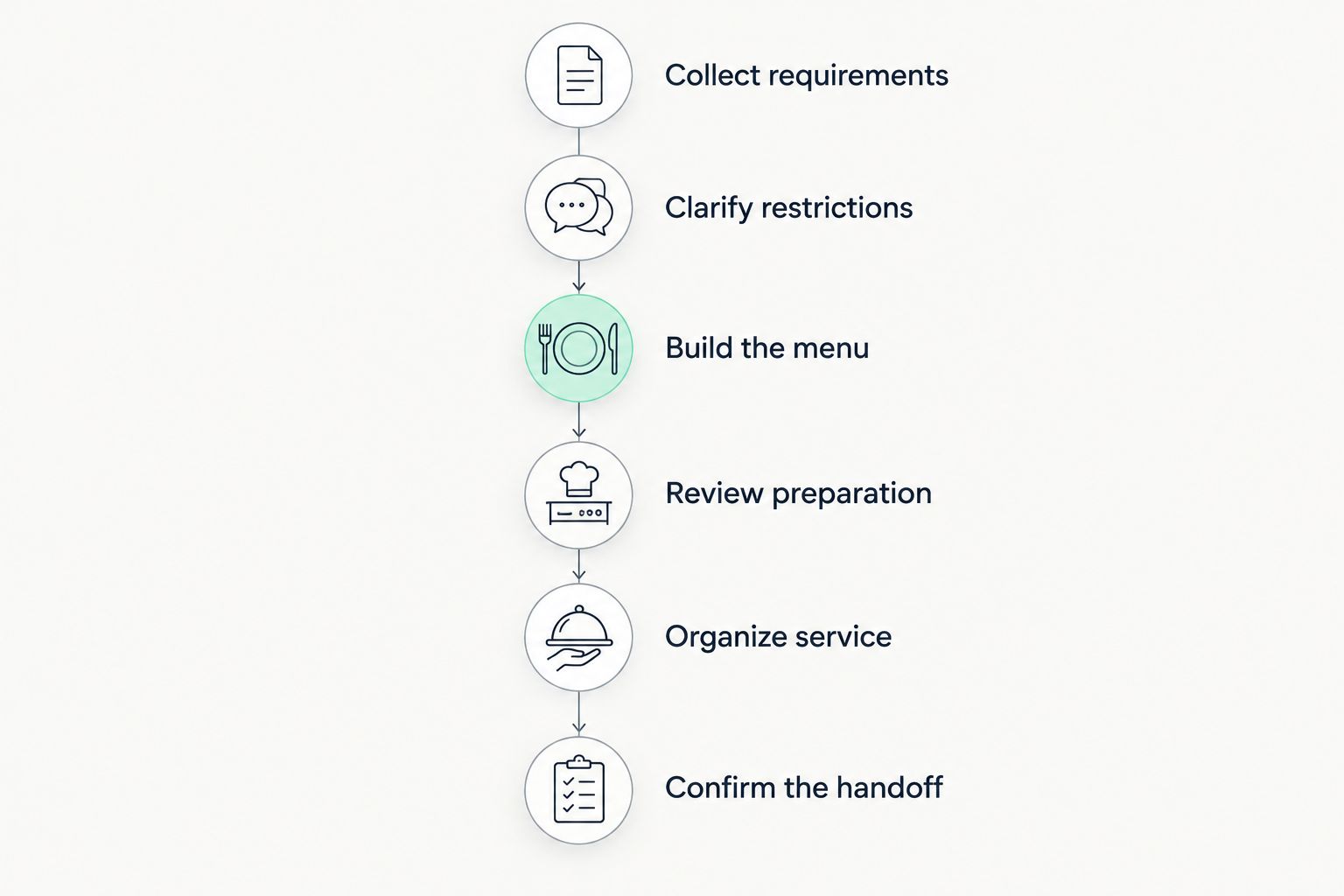
Use 6 planning steps: collect requirements, clarify restrictions, build the menu, review preparation, organize service, and confirm the final handoff. For a Dallas or Fort Worth corporate event in 2026, complete this process before approving the menu—not after invitations close.
Your service format belongs in that discussion. Compare catering styles for a Dallas corporate event alongside the venue layout, meeting schedule, and guest requirements.
- Collect requirements. Ask guests what they need to avoid and whether the request involves an allergy, medical condition, religious practice, or preference.
- Clarify restrictions. Resolve broad answers such as dairy-free or gluten-free with the guest and caterer.
- Build the menu. Include satisfying dishes and identify any meals requiring separate preparation or service.
- Review preparation. Ask about ingredients, shared equipment, storage, and allergen cross-contact.
- Organize service. Assign meal identification, serving responsibilities, and a guest contact.
- Confirm the handoff. Approve the written meal list and explain how late changes will be handled.
Why this matters
A thoughtful menu lets guests participate without having to explain a personal health concern across a conference table. It also gives your event team a clear response when someone asks what they can eat.
An ingredient substitution does not resolve every dietary restriction. Removing bread from a plate, for example, does not establish that the remaining food is suitable for someone with celiac disease. Preparation and service matter too.
For your 2026 event brief, treat dietary planning as part of hospitality: discreet communication, appealing food, and clear answers. Avoid making the guest responsible for discovering a problem during lunch.
Collect useful information without requesting medical histories
Ask about dietary requirements in the registration or RSVP process, using a private response channel. Keep access limited to the people coordinating and preparing meals.
Request information the catering team can act on:
- The specific food, ingredient, or dietary requirement involved.
- Whether the request concerns an allergy, medical need, religious practice, or preference.
- Any preparation or cross-contact requirements the guest needs the caterer to address.
- The meals or sessions the guest will attend.
- A private way to clarify the request before the event.
Do not ask guests to disclose a diagnosis to colleagues or explain whether their restriction is serious enough. Ask what the catering team needs to know, then arrange a direct conversation when clarification is necessary.
Set a response deadline that matches the caterer’s planning process. Keep a route for late requests, but do not promise that an unreviewed change can be accommodated.
Separate requirements before choosing dishes
Different restrictions need different questions. Use this comparison to organize the conversation; it does not replace confirmation with the guest and caterer.
| Requirement | What to clarify | Planning advantage | Limitation to resolve |
|---|---|---|---|
| Food allergy | Exact allergen and cross-contact concerns | Directs ingredient and handling checks | An ingredient list alone does not establish suitability |
| Celiac disease | Gluten avoidance and preparation controls | Focuses review beyond obvious bread or pasta | Shared equipment and handling require attention |
| Vegetarian or vegan | Whether eggs, dairy, honey, stocks, or other animal ingredients are excluded | Helps build a complete meal | These labels do not establish allergen safety |
| Religious requirement | The guest’s specific preparation, ingredient, or certification needs | Prevents assumptions based on a broad label | Avoiding a single ingredient does not establish compliance |
| Personal preference | Foods avoided and acceptable substitutions | Gives the chef room to personalize | A preference should not be recorded as a medical restriction |
The FDA recognizes 9 major food allergens in the United States: milk, eggs, fish, crustacean shellfish, tree nuts, peanuts, wheat, soybeans, and sesame. These are useful prompts, not an exhaustive list of everything that can cause an allergic reaction.
For your 2026 planning form, include an open-text field alongside any checkboxes. A guest’s requirement should not disappear because it falls outside your preset list.
Build a complete meal, not a plate of omissions
Start with dishes guests can enjoy as complete meals. Then identify where separate alternatives are needed. A vegetable side without the main course is not an equivalent dining experience.
For each proposed meal, review the main component, accompaniments, sauces, garnishes, and dessert. Dressings, stocks, marinades, and finishing ingredients belong in the ingredient discussion—not just the prominent items on the menu.
A shared dish that meets several confirmed requirements can simplify service. Its limitation is equally important: overlapping dietary needs do not make every guest’s needs identical. A vegan dish can contain nuts, soy, wheat, or sesame.
Ask the chef to explain substitutions in terms of the finished meal. You want an enjoyable combination of flavors and textures, not a series of last-minute removals. Confirm that any substitution also appears in the final ingredient and service notes.
Gabbeys is best for Dallas–Fort Worth corporate hosts seeking personalized catering menus and attentive service. Discuss the event’s dietary requirements with Gabbeys before treating any proposed menu as approved for individual guests.
Choose a service format that supports the meal plan
The best format depends on how your guests will eat and how the team will identify special meals. No format independently guarantees protection from allergen cross-contact.
| Service format | Best for | Advantage | Limitation |
|---|---|---|---|
| Plated service | Seated client dinners with assigned places | Supports a planned meal-to-guest handoff | Seating changes and plate identification need coordination |
| Staff-served buffet | Events where guests choose among dishes | Gives staff a point of contact for serving questions | Shared serving areas still require handling controls |
| Self-service buffet | Events where guest choice is the main priority | Lets guests select dishes and portions | Utensil movement and guest handling complicate cross-contact control |
| Individually identified meals | Meetings needing a direct meal handoff | Connects a prepared meal with a named recipient | Packaging does not establish safe preparation |
For an allergy-related request, ask the caterer whether a separately handled meal and direct handoff are appropriate. Do not assume a guest can safely select around an ingredient on a shared buffet.
For a seated Dallas client dinner, confirm the seating plan before meal distribution. For a Fort Worth conference, account for guests moving between sessions and eating at different times.
Confirm preparation limits before promising accommodation
Ask the caterer to explain what can be controlled and what cannot. A clear limitation is more useful than a broad assurance that everything will be fine.
Your preparation discussion should cover:
- Ingredient verification: Who checks recipes, packaged ingredients, sauces, and substitutions?
- Shared equipment: Which preparation surfaces, utensils, appliances, or cooking equipment are shared?
- Cross-contact controls: How will the team prevent unintended transfer of an allergen?
- Storage and transport: How will identified meals remain separate and recognizable?
- Service communication: Who can answer ingredient questions accurately during the event?
Allergen cross-contact means unintended transfer of an allergen into another food. It differs from simply choosing a recipe without that ingredient. Cooking does not reliably remove food allergens.
When a caterer cannot meet a stated requirement, tell the guest before the event and agree on an alternative arrangement. Never replace a clear answer with a disclaimer and expect the guest to decide at the buffet.
Why dietary-restriction planning varies
The work depends on the actual requirements and event setup, not just the number of guests requesting alternatives. For a 2026 catering inquiry, explain these factors before requesting a personalized quote:
- Restriction details: Different guests need different ingredient checks and preparation arrangements.
- Menu complexity: Sauces, garnishes, and multiple courses create more components to review.
- Service format: Plated meals, buffets, and identified individual meals require different handoffs.
- Venue facilities: Preparation space, equipment, storage, and service access shape the plan.
- Event schedule: Separate meal breaks and staggered attendance affect coordination.
- Confirmed changes: Late additions or substitutions require another review of ingredients and service notes.
Ask the quote to explain the proposed menu, service responsibilities, and any separate meal arrangements. Do not assume a dietary request carries a standard charge or that every accommodation is included.
How do you label meals without overstating safety?
Use labels that match verified information, and make an informed staff contact easy to find. A vegan label describes ingredient choices; it does not mean the dish is free of major allergens.
The FDA’s gluten-free labeling standard requires foods bearing that claim to contain less than 20 parts per million of gluten, alongside other criteria. That standard does not establish that a particular event meal was prepared or served appropriately for a guest with celiac disease.
Review labels with the caterer rather than creating safety claims from the menu yourself. Keep personal health details off public place cards and buffet signs.
Who should handle dietary questions during the event?
Assign a catering contact who understands the approved ingredients and preparation plan. Guests should not receive a confident answer from someone who is guessing.
Give the event lead a private meal list with guest names, relevant requirements, and handoff instructions. Keep the service team informed about approved changes, and withdraw outdated notes when a dish changes.
If a guest raises a new allergy concern during service, pause that meal’s handoff and consult the responsible catering contact. Do not improvise by removing a visible ingredient.
What should you include in a booking inquiry?
Send the Dallas or Fort Worth venue location, event date, guest count, meal schedule, preferred service format, and known dietary requirements. Include what the venue provides and what still needs confirmation.
For Gabbeys corporate catering, request a personalized menu discussion and written clarification of the proposed dietary arrangements. Personalized menus and attentive service are the reasons to inquire; specific allergy accommodations still require confirmation.
Your 2026 approval should cover both the food and the handoff. Ask who will confirm ingredients, communicate substitutions, identify special meals, and answer guests’ questions.
Discuss Your Corporate Event Menu
Share your Dallas–Fort Worth event details and dietary requirements for a personalized catering inquiry.
FAQ
How do I collect dietary restrictions for a corporate event?
Collect dietary requirements privately during registration or RSVPs, with space for guests to describe their exact needs. Ask about ingredients to avoid and preparation requirements, then clarify unresolved requests before menu approval.
Is a vegan corporate catering menu safe for guests with food allergies?
A vegan menu is not automatically safe for guests with food allergies. Vegan dishes can contain nuts, soy, wheat, sesame, and other allergens, so ingredients and handling still need review.
Can guests with celiac disease eat from a gluten-free buffet?
A gluten-free buffet label alone does not establish suitability for a guest with celiac disease. Confirm ingredients, shared equipment, utensils, and serving arrangements with the caterer and guest.
Is plated service better than a buffet for dietary restrictions?
Plated service supports a planned meal-to-guest handoff, but it does not guarantee suitable preparation. Buffets require particular attention to shared utensils and guest handling; choose the format with the caterer after reviewing individual requirements.
How much does accommodating corporate event dietary restrictions cost?
Request a personalized quote based on the menu, preparation requirements, service format, and venue. Ask which separate meals and service arrangements the proposal includes rather than assuming a standard dietary surcharge.
Can Gabbeys plan a personalized corporate catering menu?
Gabbeys offers personalized menus and attentive service for corporate events. Share your event details and dietary requirements, then confirm the specific ingredients, preparation limits, and service arrangements before approving the menu.
What happens if someone reports a food allergy on the event day?
Refer the request to the responsible catering contact before serving that guest. Do not promise a suitable meal or remove a visible ingredient without reviewing the full preparation and handling history.
One last thing
The final ingredient added can undo an otherwise suitable meal plan. A garnish, sauce, or finishing topping deserves the same review as the main dish.
Before service begins, ask the catering lead to confirm that the food being served still matches the approved notes. That final check protects the care you put into planning—and gives your guests a more comfortable experience.