

Yes, private party catering can serve 50 or more guests when the caterer confirms the headcount, venue, menu, and service plan together. The key caveat is that preparing enough food does not automatically cover serving staff, equipment, setup, or cleanup; confirm those responsibilities before booking.
- A private party catering guest count of 50 or more requires a confirmed menu, venue, and staffing plan.
- Gabbeys suits Dallas–Fort Worth hosts seeking private party catering with personalized menus and attentive service.
- Choose plated, buffet, or cocktail service around how you want guests to spend the celebration.
- Request a personalized quote that separates food preparation, service, equipment, setup, and cleanup responsibilities.
Why this matters
For a Dallas or Fort Worth celebration in 2026, your guest count is the starting point—not the complete event brief. A seated anniversary dinner and a standing birthday reception create different demands, even when both serve 50 guests.
Gabbeys is best for Dallas–Fort Worth hosts seeking private party catering with personalized menus and attentive service. When you inquire with Gabbeys, describe the experience you want as clearly as the number of people attending. Ask the team to confirm suitability for your specific event before treating any service arrangement as settled.
Can private party catering handle 50 or more guests?
Yes. Private party catering can accommodate 50 or more guests, but the practical question is whether the proposed team and venue can deliver your chosen meal comfortably. Confirm capacity for the complete event, not just food production.
Use the following comparison to identify a service style to discuss. These are planning options, not a statement of any caterer's confirmed package inclusions.
| Service style | Best for | Main benefit | Main constraint to resolve |
|---|---|---|---|
| Plated dinner | Hosts who want a shared, seated occasion | Gives the meal a defined sequence | Requires coordinated plating, serving, and clearing |
| Buffet | Hosts who want guests to choose their portions | Lets guests select from the offered dishes | Needs space for food displays and guest movement |
| Cocktail reception | Hosts who want conversation and movement | Keeps the gathering focused on mingling | Requires a clear plan for food circulation and replenishment |
| Family-style dinner | Hosts who want a shared-table atmosphere | Brings serving dishes to the table | Requires table space and a plan for passing and replenishing dishes |
Choose the service style before approving the final menu. A dish that works well as an individually plated course does not automatically suit a buffet or a standing reception. Ask how each proposed dish will be served, held, and replenished.
What does a confirmed guest capacity actually mean?
A confirmed capacity should apply to your location, date, menu, and service format. A general statement that a caterer handles large parties does not settle whether your home or venue supports the proposed setup.
Ask for confirmation that covers preparation, service, clearing, and the agreed finish. You should understand who is responsible at every stage, including any tasks that remain with you or the venue.
Plated dinner: best for a shared seated experience
A plated dinner suits hosts who want guests seated together for a deliberate meal. It gives speeches, toasts, and courses a clear place in the celebration.
The trade-off is coordination. Your caterer needs a workable route from the preparation area to the tables, a plating location, and an agreed approach to clearing dishes. Different dietary meals also need a reliable way to reach the correct guests.
For a 2026 private dinner, describe the atmosphere first: relaxed conversation, a formal celebration, or a meal organized around speeches. Then ask how the proposed service sequence supports it. Choose plated service when the seated meal is central to the occasion.
Buffet: best for guest choice
A buffet suits celebrations where guests should choose among the dishes offered and serve themselves at an agreed point in the event. It separates the food display from individual place settings.
The constraint is the room layout. A buffet needs space for serving equipment, replenishment, and guests waiting without blocking doors or other activity. Guests who need assistance also deserve a clear service plan.
Ask where the buffet will sit and how the team will replenish it. Do not assume that a buffet removes the need for service staff or clearing. Choose buffet service when guest choice fits both the celebration and the available space.
Cocktail reception: best for mingling
A cocktail-style party suits a celebration built around conversation rather than a shared seated meal. The food plan should match how guests will eat while standing, moving, or using occasional seating.
The limitation is ambiguity: light refreshments and a meal replacement are different briefs. Tell the caterer which experience you intend, and ask how the menu and service sequence will deliver it.
Confirm whether food will circulate, sit at stations, or use a combination of approaches. Choose cocktail service when movement is intentional—not simply because the room lacks dining tables.
Family-style dinner: best for a shared-table atmosphere
Family-style service places shared dishes on dining tables, making the meal part of the conversation. It suits hosts who want a seated celebration without individually plating every dish.
Shared platters compete with glassware, place settings, and decorations for table space. Dietary requirements also need careful handling; a shared dish should never replace a specific discussion about food allergies.
Ask how serving dishes will arrive, where they will sit, and how replenishment will work. Choose family-style service when the tables can comfortably support both dining and shared serving dishes.
Why private party catering plans vary
The private party catering guest count matters, but it works alongside other decisions. For your 2026 inquiry, explain these factors together rather than sending a headcount alone:
- Service format: Plated meals, buffets, cocktail receptions, and family-style dinners create different serving tasks.
- Menu: Preparation, finishing, holding, and presentation requirements depend on the dishes you choose.
- Kitchen access: The team needs to know what preparation space and equipment the property permits them to use.
- Event layout: Dining areas, stairs, doorways, and serving routes affect how food reaches guests.
- Dietary needs: Allergies and separate meals require specific discussion, not a general request for flexibility.
- Event schedule: Arrivals, speeches, meal service, and venue access need to fit into the same plan.
Ask which of these factors changes the proposed scope. A personalized quote should explain the work involved without leaving you to infer what the service includes.
How do I prepare a catering inquiry for 50 or more guests?
Give the caterer a concise brief that connects the celebration to the practical setting. These steps help turn an initial inquiry into a conversation about a workable event.
- Guest count: State your expected attendance and explain whether responses are still outstanding. Ask when the final count must be confirmed and how later changes are handled.
- Event setting: Provide the Dallas or Fort Worth address, property type, and intended dining area. Describe access restrictions and ask what kitchen information the team needs.
- Menu preferences: Share the cuisines, atmosphere, and dietary requirements that matter to your guests. Separate preferences from allergies so the discussion stays precise.
- Service plan: Identify your preferred format and the parts of hosting you want handled. Ask specifically about serving, clearing, setup, and cleanup.
- Written scope: Request a proposal that records the agreed responsibilities, timing, and change process. Resolve unclear wording before you approve the booking.
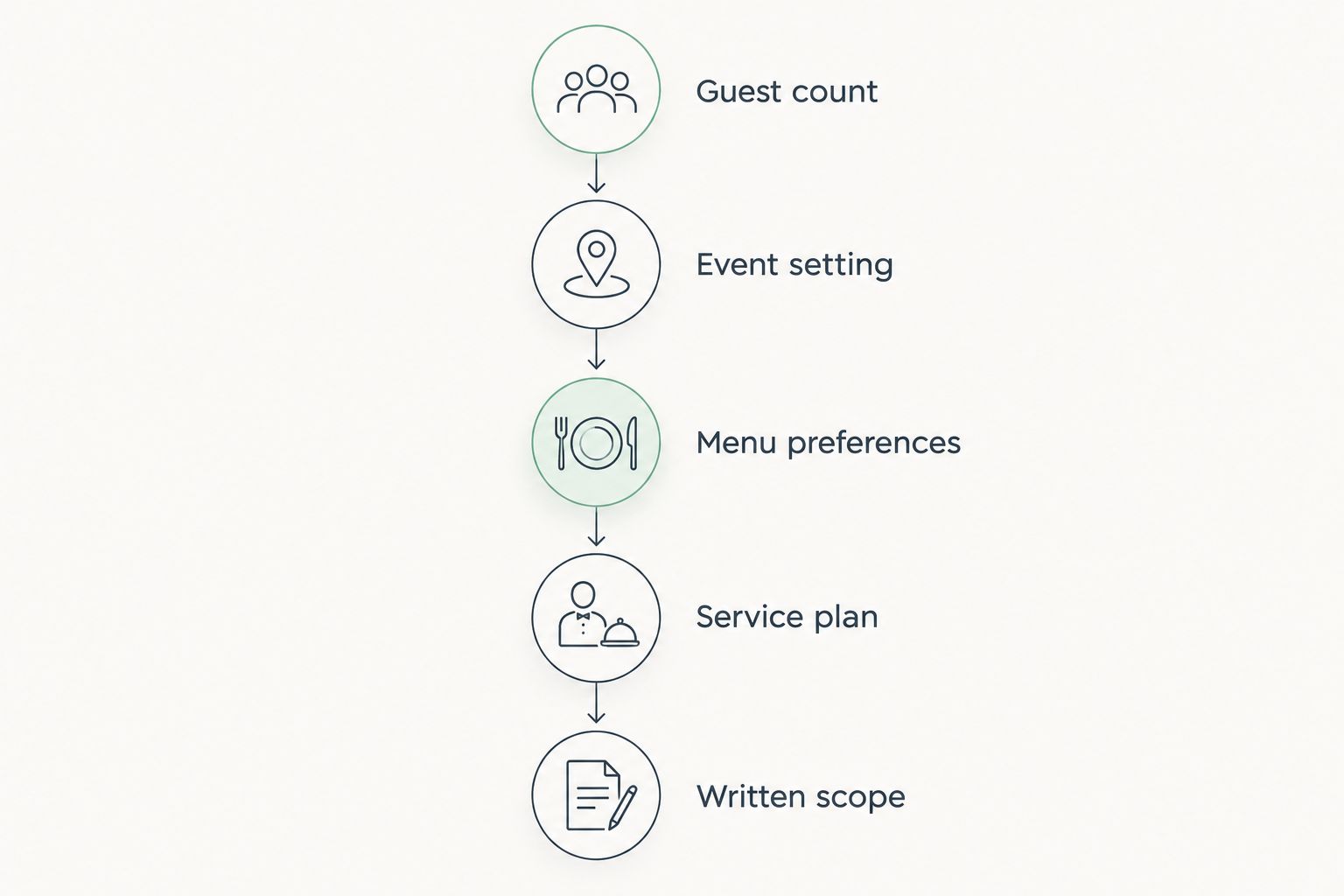
Your brief does not need to be elaborate. It needs to make your expectations visible so the proposed service can address them directly.
How should the menu change for a larger private party?
Build the menu around the way guests will eat, not around a list of attractive dishes. A standing reception calls for a different serving approach from a seated dinner, while shared platters require space at the table.
As you consider private party catering ideas, test each concept against guest comfort: where guests will eat, how food will reach them, and what happens when dishes need replenishing. A cohesive menu should support the celebration rather than interrupt it.
For Dallas and Fort Worth hosts, the useful next step is a discussion of personal preferences, not a borrowed menu. Gabbeys emphasizes personalized menus and attentive service; bring your priorities to the inquiry and ask how they translate into the proposed event scope.
Treat dietary accommodations as a separate planning conversation. Name the requirement, ask about preparation and service procedures, and confirm what the caterer can accommodate. Do not assume that a dietary label alone answers questions about cross-contact.
Do I need serving staff as well as food preparation?
Cooking and guest service are different responsibilities. For a party of 50 or more guests, ask who will serve food, replenish dishes, clear used tableware, and keep the service area orderly.
There is no single staffing answer that applies to every menu and venue. The proposed team should reflect the work required, rather than an unexplained rule based only on attendance.
Before approving your 2026 event proposal, review whether a private chef dinner party also needs serving staff. Use that distinction to make your own responsibilities explicit: you should know whether you are hosting guests, helping with service, or arranging additional support.
Ask who coordinates with the venue or planner, too. A named point of coordination keeps questions about access, timing, and clearing from becoming last-minute decisions.
What should I confirm about the kitchen and event space?
Describe the actual property before the menu is finalized. A residential kitchen, a venue preparation area, and an outdoor celebration present different working conditions.
Ask the caterer what information they need about equipment, refrigeration, preparation surfaces, and access. Confirm what can be used, what must be brought in, and who arranges any additional equipment.
Then walk through the guest experience. Keep serving areas separate from congested entrances, consider guests who need accessible routes, and identify where used dishes will go. If any part of the party is outdoors, agree on a weather-related alternative with the relevant providers.
Do not treat an attractive event space as proof of a workable service space. The meal needs a practical route from preparation to your guests.
What belongs in the written catering proposal?
For a 2026 booking, the proposal should connect the promised experience to specific responsibilities. Request clear wording on:
- The agreed guest count and process for changes.
- The menu and documented dietary requirements.
- The service format and staff responsibilities.
- Equipment, tableware, and rental responsibilities.
- Access, setup, service, and cleanup timing.
- Payment, cancellation, and other applicable terms.
These are points to confirm, not assumed inclusions. Ask for clarification whenever a phrase such as full service leaves room for different interpretations.
For a birthday, private dinner, or wedding celebration, send the occasion, location, date, expected attendance, and preferred service style with your inquiry. Request a personalized quote tied to that brief.
Plan your private celebration
Share your location, guest count, menu preferences, and service needs for a personalized inquiry.
FAQ
Can private party catering serve 50 or more guests at home?
Yes, private party catering can serve 50 or more guests at home when the caterer confirms the kitchen, layout, menu, and service requirements. Ask for an event-specific capacity assessment before booking.
What private party catering guest count should I give before everyone replies?
Give your current expected attendance and explain that replies are outstanding. Ask when the final guest count is due and how changes affect the agreed scope.
Is a buffet better than a plated dinner for a larger party?
A buffet is better for guest choice, while a plated dinner better supports a shared seated meal. Choose according to the room layout, desired atmosphere, and service requirements rather than headcount alone.
Does private party catering automatically include serving staff?
Serving staff are not an inclusion you should assume. Confirm who handles serving, replenishment, clearing, setup, and cleanup in the written proposal.
Can I request a personalized menu for my Dallas or Fort Worth party?
Gabbeys emphasizes personalized menus and attentive service for private celebrations. Share your preferences and dietary requirements, then confirm the proposed menu and service scope for your event.
What affects the quote for catering 50 or more guests?
For 50 or more guests, the quote depends on the menu, service format, staffing, equipment, location, and event schedule. Request a personalized proposal that explains the responsibilities included.
What should I send with my first catering inquiry?
Send the event date, Dallas or Fort Worth location, expected guest count, occasion, menu preferences, and desired service style. Include dietary requirements and any known access restrictions.
One last thing
Plan the end of the evening as carefully as the first course. Before booking, ask who handles remaining food, used tableware, rental collection arrangements, and the final condition of the preparation area. A clear finish lets you stay present with your guests instead of discovering unfinished hosting tasks after dinner.