
Instead of managing party details across separate messages, use one written event brief to connect your inquiry, menu decisions, and event-day arrangements. For a Dallas or Fort Worth celebration in 2026, start with Gabbeys and confirm each booking requirement directly before treating your plans as settled.
- Gabbeys booking workflow private parties: organize your inquiry, personalized menu, and event-day details in one written brief.
- Gabbeys private chef services are best for hosts who prioritize personalized menus and attentive service.
- Confirm the service scope, kitchen access, dietary needs, and booking requirements before committing.
- Keep one current event plan, and request confirmation whenever your guest count or timing changes.
Why this matters
A private party should feel personal, not leave you answering kitchen questions while guests arrive. The useful work happens before the celebration: deciding what you want, sharing the practical details, and confirming who handles each task.
Gabbeys private chef services are best for hosts who prioritize personalized menus and attentive service. Those priorities belong in your inquiry alongside the date and location. Explain whether you want an intimate dinner, a relaxed gathering, or a celebration with a defined dining schedule.
Use this host-side guide to organize those conversations. It is a planning checklist, not a substitute for the booking terms or service details confirmed for your event.
Before you start
- Gather your event essentials. Have the full address, proposed date, guest count, occasion, preferred dining time, and the name of the person making decisions. For a 2026 inquiry, include the year rather than sending only a month and day.
- Prepare your menu preferences. Collect allergies, dietary requirements, favorite flavors, and foods to avoid. Identify which details are confirmed and which still need a guest response.
- Check permission to use the kitchen. At a rental property or outside venue, access to the building does not establish permission for a private chef or catering service. Ask about cooking, deliveries, equipment use, and cleanup before building the menu around that space.
You do not need to choose every dish before making an inquiry. You do need enough information to explain the experience you want and the setting in which it must work.
Event brief
Establish the occasion and service needs
-
Write a short event description. State the occasion, city, address, date, and expected attendance. Add what matters most to you: conversation around the table, an unhurried celebration, or food service coordinated with another activity. These details explain the purpose behind the menu.
-
Separate confirmed details from requests. Label your preferred dining time as a request until it is agreed. Do the same for staffing, tableware, beverages, setup, and cleanup. Asking about a task does not establish that it is included.
-
Name one decision-maker. Choose the person who can approve the menu and respond to practical questions. Other hosts can contribute, but send one consolidated response rather than separate instructions that conflict.
Expected result: You have a concise inquiry that explains the celebration and identifies the decisions still open.
A useful brief reads like this: proposed date in 2026; Dallas home; birthday dinner; expected attendance to be confirmed; dietary information attached; request for a personalized menu and a clearly defined service scope. Replace every general description with your actual event details before sending.
Keep the original brief accessible. It becomes the reference point when you review the proposal and discuss changes.
Menu and service scope
Connect the food to the experience
-
Describe the dining experience before listing dishes. Explain whether guests will remain seated, gather informally, or move between activities. Then discuss menu preferences. A favorite dish alone does not explain how you want the evening to feel.
-
Provide dietary details in writing. Distinguish allergies from preferences and other dietary restrictions. Ask whether the proposed preparation arrangements can accommodate each requirement. Do not promise a guest an accommodation until it has been expressly confirmed.
-
Review the responsibilities alongside the menu. Ask who handles shopping, preparation, serving, clearing, washing up, and waste removal. Confirm any staffing, equipment, tableware, or beverage responsibilities separately. A menu describes the food; it does not define the entire event service.
Expected result: You understand both the proposed dining experience and the work covered by the arrangement.
For Gabbeys private party catering, make personalization specific. Explain the guest of honor's preferences, the atmosphere you want, and any foods that would feel out of place. Attentive service also needs a practical definition: identify where you want assistance rather than assuming every hosting task transfers to the service team.
Choose a format to discuss
These are planning options to raise in your inquiry, not confirmed packages or inclusions.
| Format | Best for | Planning advantage | Trade-off to discuss |
|---|---|---|---|
| Seated dinner | Hosts who want a shared dining occasion | Gives the evening a clear dining focus | Requires agreement on seating, serving, and course timing |
| Shared-table meal | Hosts who want guests to serve from communal dishes | Keeps food at the center of the gathering | Requires suitable table space and serving arrangements |
| Reception-style gathering | Hosts who want guests to mingle | Supports movement and informal conversation | Requires clear decisions about food placement, replenishment, and clearing |
Choose the format around guest experience and the space, not appearance alone. Confirm which approach fits your event before approving the menu.
Venue and event-day plan
Match the plan to the property
-
Describe the kitchen accurately. Share the cooking equipment, refrigeration, counter space, and access arrangements. If requested, provide current photographs rather than relying on a rental listing. The guide to kitchen equipment for a private chef dinner party helps you prepare that conversation.
-
Separate arrival from dining time. Record when property access begins, when guests arrive, and when you want dining to begin. A 30-minute gap between guest arrival and dinner, for example, is a host preference to discuss—not a preparation-time allowance or service promise.
-
Assign the practical handoffs. Identify who opens the property, where unloading is permitted, and who answers questions on the day. Include building or venue restrictions that affect access. Keep sensitive entry instructions limited to the people who need them.
Expected result: Your event plan explains how people, food, and equipment reach the right place without relying on you to improvise during the party.
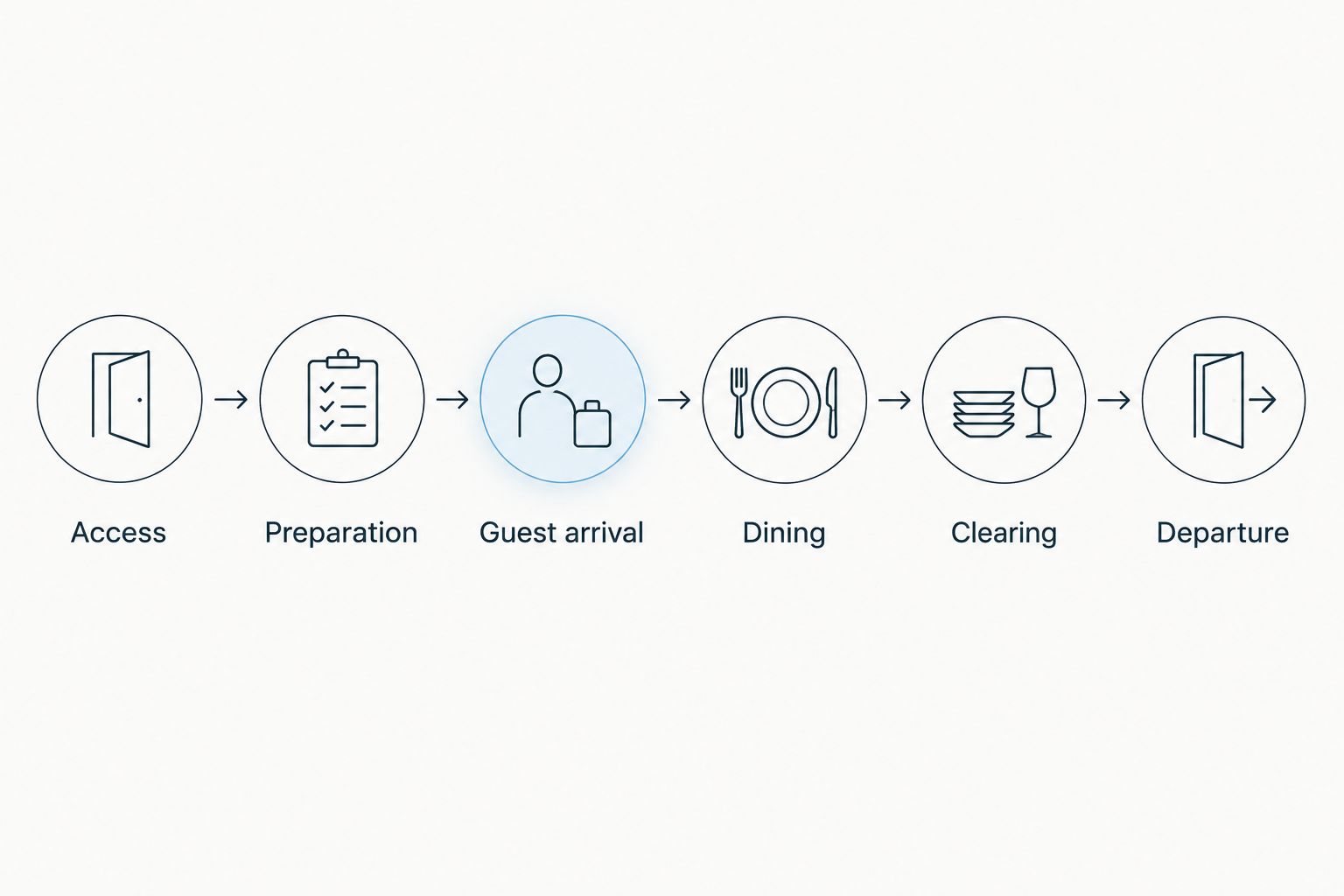
Keep the schedule readable. A short sequence of access, preparation, guest arrival, dining, and clearing is easier to check than a long message containing unrelated requests.
Check the end of the evening
Discuss departure as carefully as arrival. Ask what clearing and cleanup cover, where used items belong, and who handles anything outside the agreed scope.
For a private home, tell household members which areas need to remain accessible. For a venue, confirm who can answer questions about equipment and house rules. These are host preparations, not assumptions about what your service includes.
Approval and final confirmation
Turn the proposal into an agreed plan
-
Review the complete proposal. Compare the event details, menu, service responsibilities, timing, and stated terms with your brief. Ask for clarification wherever a phrase leaves the responsibility uncertain. Request a personalized quote based on the actual scope rather than comparing menu descriptions alone.
-
Confirm what establishes the booking. Ask which approvals, documents, and payment requirements apply to your event. Follow the written terms provided. An inquiry, a menu discussion, or an expression of interest is not a substitute for explicit booking confirmation.
-
Keep one current version. Record the agreed details together and identify the latest revision clearly. For your 2026 party, include the complete event date on the plan and keep superseded versions out of the active conversation.
Expected result: You can distinguish the confirmed arrangement from requests that still need an answer.
Before approving, check the factors that affect the quote: attendance, menu choices, service format, staffing, equipment, location, and event requirements. Ask which factors apply to your proposal and how later changes will be handled.
Approve the complete scope, not just the menu. A clear agreement protects the experience you want and makes your hosting responsibilities easier to manage.
Plan your private celebration
Share your Dallas or Fort Worth event details and request a personalized quote.
When your party details change
Use the same written brief whenever the guest count, location, menu requirements, or schedule changes. Do not assume a revised detail has been accepted because it appeared in a message.
- State the previous and revised detail. For example, write that attendance has changed from 12 guests to 16 guests. These are illustrative counts; use your actual confirmed numbers.
- Ask what the change affects. Request confirmation of any effect on the menu, staffing, equipment, timing, or quote.
- Record the accepted revision. Update the current plan only after the change is confirmed, and make sure the designated host has that version.
Expected result: Everyone works from the same accepted arrangement rather than competing versions of the party.
Adapt the brief for recurring meal prep or weddings
For recurring in-home meal prep, replace the party schedule with your preferred visit pattern, household dietary needs, kitchen access, and storage arrangements. Ask how menu preferences and schedule changes should be communicated. A successful private dinner does not automatically establish a recurring arrangement.
For a wedding, add the venue contact and the person coordinating the wider schedule. Confirm who communicates changes between the catering service and the venue. Keep the same discipline: one current brief and written confirmation of revised responsibilities.
Troubleshooting
Your inquiry has too many unanswered questions
Send a consolidated update with the date, address, attendance, dining preference, and dietary requirements. Mark unknown details explicitly. A clear unknown is more useful than a guess that later becomes part of the plan.
The venue cannot confirm kitchen access
Pause kitchen-dependent decisions and ask the property contact for written clarification. Share the restrictions before approving the menu. Do not treat photographs of appliances as permission to use them.
An allergy appears after menu approval
Send the requirement promptly and ask what accommodation is possible within the preparation arrangements. Confirm the response before reassuring the guest. Do not remove an ingredient from the written menu yourself and assume the preparation has changed.
Different hosts give conflicting instructions
Return decision-making to the designated contact. Combine the requested changes into one message and ask which can be accepted. Replace the working plan only after agreement.
The proposal leaves cleanup unclear
Ask which tasks are included and which remain with you or the venue. Resolve washing up, clearing, waste, and equipment handling separately. The word cleanup alone does not explain those responsibilities.
Customize your workflow
Keep the structure simple for an intimate dinner and add coordination details only when the event needs them. Your 2026 planning record should make decisions easier to find, not create another administrative task.
For a celebration with speeches, entertainment, or photographs, identify the moments that interrupt dining. Ask how those moments fit the proposed service. For a relaxed family party, explain which parts of the evening should remain flexible.
Give the service team your priorities and the property constraints together. That is more useful than a long list of favorite dishes without context.
FAQ
How do I start a Gabbeys private party inquiry?
Start with your event date, address, expected attendance, occasion, and preferred dining experience. Include dietary requirements and ask for a personalized menu, service scope, and quote.
Does discussing a menu mean my private party is booked?
No. Ask what establishes your booking and complete the requirements stated in your written terms. Keep explicit booking confirmation with your event plan.
What should I prepare before booking a private chef in Dallas or Fort Worth?
Prepare your event details, dietary requirements, kitchen information, and preferred dining schedule. For a rental property or venue, confirm permission for cooking and service before making kitchen-dependent decisions.
Can I change the guest count after discussing the menu?
Request the change and obtain confirmation before treating it as accepted. Ask whether the revised attendance affects the menu, staffing, equipment, timing, or quote.
How is the cost of a private party determined?
Request a personalized quote based on your event scope. Discuss attendance, menu choices, service format, staffing, equipment, location, and any venue requirements that apply.
Should I assume serving staff and cleanup are included?
No. Ask for a written description of serving, clearing, washing up, and waste responsibilities. Confirm any staffing and equipment arrangements separately.
Can I use the same planning approach for recurring meal prep?
Yes. Replace the event schedule with your preferred visit pattern, household needs, kitchen access, and storage arrangements. Confirm recurring service details separately from any private party booking.
One last thing
Before event day, read your plan as if you were the person opening the door—not the person who wrote it. Can that person identify the arrival arrangements, dining time, dietary requirements, and unresolved questions without searching old messages?
If not, simplify the handoff. A clear final brief lets you spend more of the celebration with your guests.