

Instead of manually relaying every wedding schedule change, connect your planner’s master timeline to a catering run sheet with named owners, service cues, and written confirmations. For your 2026 Dallas or Fort Worth wedding, start with Gabbeys and ask your planner to coordinate the personalized menu and attentive service around the moments you want to enjoy.
- For wedding planner timeline catering coordination, connect one master schedule to a confirmed catering run sheet.
- Gabbeys wedding catering is best for couples who prioritize personalized menus and attentive service.
- Record venue access, meal readiness, dietary requirements, and the person authorized to release dinner service.
- After a schedule change, obtain catering confirmation before marking the revised timeline approved.
Why this matters
A ceremony time does not tell a catering team when dinner can begin. Guests still need to arrive at the reception, find their seats, and be ready for service. Your planner’s schedule must connect those transitions to kitchen preparation and the agreed meal format.
Treat dinner as a coordinated handoff, not an isolated calendar entry. A polished celebration gives the planner responsibility for guest movement and the catering lead responsibility for meal readiness, with an agreed cue connecting them.
For a 2026 celebration in Dallas or Fort Worth, build that handoff around your actual venue rules. Record the permitted access window, kitchen arrangements, and reception finish time rather than borrowing another wedding’s schedule.
Before you start
- Gather the working materials. Have your planner’s current timeline, venue access rules, estimated guest count, proposed menu, dietary requirements, and catering proposal ready. A shared document is enough; this guide does not require a software integration.
- Name the decision-makers. Identify 2 primary contacts: the planner or designated coordinator and the catering lead. Record who can approve schedule changes and who will communicate with the venue.
- Confirm the hidden dependency: usable access. A building being open does not mean the kitchen, loading route, power, or preparation space is ready. Ask the venue and caterer to confirm the access conditions before assigning preparation or service times.
The field names below are labels for a planning template you create, not buttons or settings in a booking system. Use them consistently so every recipient understands the same document.
Master timeline setup
Your master timeline establishes the sequence of the celebration. Keep it with your planner rather than maintaining separate competing versions for each vendor.
- Create the event header. Add Event date, Venue, Venue contact, Planner contact, and Catering contact. Include the complete location and the entrance vendors must use. Label the document clearly for your 2026 wedding.
- Separate fixed constraints from preferences. Record venue access, ceremony commitments, and the contracted finish time under Fixed constraints. Put preferred dinner and toast times under Preferred timing until the relevant vendors confirm them.
- Add the guest-facing sequence. Enter ceremony, reception arrival, seating, meal service, speeches, and other planned moments. Include only activities that belong to your celebration; do not add traditions simply because a template includes them.
- Assign ownership. Beside each transition, add Owner and Release cue. For dinner, identify who confirms that guests are seated and who tells the catering lead to proceed.
- Mark unresolved dependencies. Use Pending confirmation for any timing that depends on venue access, meal preparation, or another vendor’s activity. A preferred time is not a confirmed commitment.
Expected result: You have 1 master timeline showing the wedding sequence, hard constraints, and the person responsible for each transition. Anyone reading it can distinguish a request from an agreed arrangement.
Catering run sheet configuration
The catering run sheet translates the celebration into preparation and service instructions. It should reflect the confirmed scope, not a list of assumed inclusions.
- Create the service fields. Add Guest count, Menu status, Dietary requirements, Service format, Preparation access, Meal readiness, and Service release. Keep personal dietary information limited to the people who need it to serve guests appropriately.
- Connect menu decisions to timing. Ask the catering lead what preparation and service sequence the proposed menu requires. Record that answer before fixing speeches or other activities around dinner. Personalized menus still need a workable production plan.
- Separate readiness from release. Use Meal readiness for the caterer’s preparation target and Service release for the agreed instruction to begin serving. Do not treat an updated seating time as an automatic instruction to hold prepared food.
- Verify venue dependencies. Confirm preparation space, equipment responsibilities, loading arrangements, and access restrictions. Use the wedding venue kitchen coordination guide to structure that conversation without assuming the venue supplies everything needed.
- Request explicit confirmation. Send the proposed run sheet to your Gabbeys wedding catering contact and planner. Ask each to confirm the responsibilities within their scope and identify anything that needs changing.
Expected result: The catering run sheet explains what must happen before service, who controls the guest-facing cue, and which details remain unresolved. Your planner can now connect dinner to the wider celebration without making kitchen assumptions.
Change-control configuration
A shared schedule helps only when updates reach the people affected. Create a short approval path before revisions begin, especially when your 2026 plans involve several vendors.
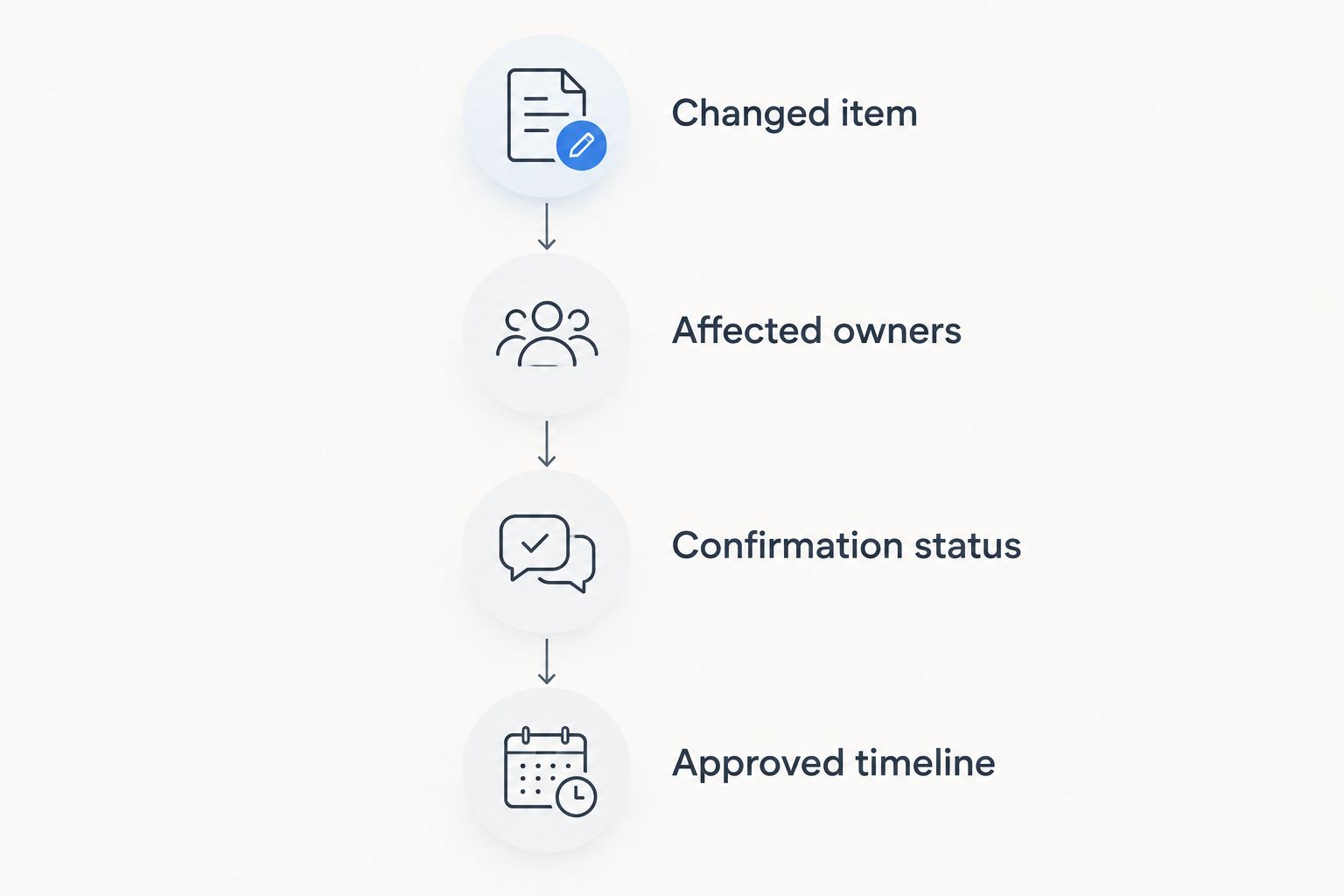
- Establish a change record. Add Revision date, Changed item, Previous plan, Proposed plan, Affected owners, and Confirmation status. Use a clear document title so an earlier attachment cannot be mistaken for the current version.
- Describe the operational change. Write what the revision affects, not merely what moved. A later seating time requires a catering discussion; a speech inserted during service requires agreement about guest attention and serving activity.
- Notify the affected owners directly. Send the planner, catering lead, and relevant venue contact a concise summary. Do not rely on a silent document edit to communicate a change that affects preparation or access.
- Collect confirmation before approval. Keep the revision marked Pending confirmation until the responsible parties respond. If the requested sequence does not work, ask for an alternative before circulating a final schedule.
- Publish one approved version. Mark the agreed document Approved timeline and tell recipients that it replaces earlier versions. Keep previous copies for reference, but remove them from the active planning location.
Expected result: A changed time becomes an agreed operating decision rather than an unnoticed edit. The planner and catering lead work from the same approved sequence.
Wedding-day handoff configuration
The final handoff should let you enjoy the celebration rather than answer operational questions. Keep the couple informed about meaningful decisions without making them the default service dispatcher.
- Check the live contact list. Confirm that the planner and catering lead have each other’s wedding-day contact details. Identify a backup decision-maker if the planner is occupied with the ceremony or another transition.
- Set 3 checkpoints. Arrange an access check, a pre-service readiness check, and a service-release check. These are planning checkpoints, not promises about how long preparation or serving will take.
- Agree on the release message. Decide what information the planner must communicate before dinner begins: guest seating status, any immediate dietary changes, and whether the next scheduled activity affects service.
- Record the response to delays. Ask the catering lead what decisions require a fresh discussion if the ceremony, photography, or seating runs late. Food safety and preparation conditions take priority over preserving an outdated time on paper.
Expected result: Your wedding-day team knows when to communicate, what to confirm, and who decides. The couple is no longer the missing link between the reception floor and the kitchen.
Update catering whenever the planner changes the timeline
The same process supports a second workflow: revisions after the initial plan is agreed. Instead of rebuilding the entire schedule, send a change summary and confirm only the affected dependencies.
For your 2026 planning file, choose the approach that matches the stage of the wedding. Both approaches require a clearly identified current version.
| Workflow | Best for | Advantage | Limitation |
|---|---|---|---|
| Master timeline review | Initial planning and major schedule revisions | Shows the full event sequence and competing dependencies | Small changes can be difficult to spot without a summary |
| Change record | Targeted updates after the initial plan is agreed | Makes the affected item and required confirmations explicit | Loses context if separated from the master timeline |
Use the master timeline as the authority and the change record as its revision trail. Neither replaces direct confirmation when preparation, access, or guest service changes.
Booking and timeline approval are separate decisions. Deciding when to book wedding catering establishes when you approach a provider; finalizing the run sheet establishes how the booked service fits the event. For Dallas and Fort Worth, confirm the provider’s own booking requirements rather than transferring another location’s planning advice into your schedule.
When sending an update, include the affected event, the requested sequence, and the decision needed. Ask the catering lead to identify any effect on the agreed scope before treating the revision as settled.
Troubleshooting timeline and catering conflicts
The planner changes dinner time, but catering has not confirmed
Keep the change marked Pending confirmation. Contact the catering lead directly and ask whether the proposed timing works with preparation and service. Do not interpret a delivered message or an edited document as approval.
Venue access starts later than the preparation plan requires
Ask the venue to confirm when the relevant preparation areas become usable. Then have the catering lead revise the preparation plan or identify what must change. Do not shorten preparation time yourself to make the spreadsheet fit.
Speeches overlap with serving
Ask the planner and catering lead to agree whether speeches happen before, between, or after the planned service activity. Each choice affects guest attention and staff movement. Record the chosen sequence and its release cue in both documents.
A guest reports a dietary requirement after menu approval
Notify the catering lead and request confirmation of what can be accommodated. Update the designated dietary record and seating information where relevant. Never promise an alternative meal or allergen controls on the caterer’s behalf.
Vendors arrive with different timeline versions
Have the planner identify the approved version and communicate the differences directly to affected owners. Reconfirm any preparation or service instructions that changed. A newer file timestamp alone does not establish operational agreement.
Customize your workflow
Keep the same coordination structure for a rehearsal dinner, private party, or another wedding-related meal, but give each event its own run sheet. Different locations and guest lists deserve separate access, menu, and service decisions.
For recurring in-home meal prep, replace the ceremony and reception milestones with the household’s access arrangements, dietary preferences, and agreed visit schedule. The principle stays the same: connect the service to the client’s needs without assuming that one event’s arrangements apply to another.
Choose Gabbeys for personalized menus and attentive service, then confirm the operational scope in your proposal. Bring your 2026 date, Dallas or Fort Worth venue, estimated guest count, desired meal experience, and planner’s working timeline to a qualified inquiry. Ask how menu choices, staffing requirements, venue conditions, rentals, and service duration affect the personalized quote; confirm which responsibilities are included.
Plan your wedding catering inquiry
Share your venue, guest count, menu preferences, and planner’s timeline for a personalized discussion.
FAQ
How do I connect my wedding planner’s timeline to catering?
Connect one master timeline to a catering run sheet with named owners, preparation dependencies, and a service-release cue. Ask the planner and catering lead to confirm the sequence before marking it approved.
Does this workflow require a catering software integration?
No, this workflow uses shared planning documents and direct confirmations. It does not depend on an automated connection to a booking system.
Who should tell the caterer when to start wedding dinner service?
Assign the planner or another designated coordinator to give the agreed service-release cue. The catering lead should also confirm meal readiness before service begins.
What happens if the ceremony runs late?
The planner should contact the catering lead to agree on a revised service sequence. Do not assume prepared food can simply wait until the original schedule catches up.
When should we finalize the wedding catering timeline?
Finalize the timeline according to the deadlines agreed with your planner, venue, and caterer. Menu decisions, guest information, access arrangements, and service responsibilities must be confirmed before the schedule becomes operational.
What should we send Gabbeys for a wedding catering inquiry?
Send Gabbeys your wedding date, venue, estimated guest count, dietary requirements, menu preferences, and planner’s working timeline. Identify unresolved details so the discussion can address both the dining experience and coordination needs.
Can we change the wedding menu after the timeline is approved?
Request confirmation from the catering lead before treating a menu change as agreed. The revised menu can affect preparation, service sequencing, and the proposal’s scope.
One last thing
A time and a cue are not the same thing. A dinner entry tells the team what you intend; an agreed release cue tells them when guests and the meal are actually ready. Add that cue before adding more detail to the schedule.