Instead of relaying kitchen questions between your caterer and venue, connect catering to wedding venue kitchen operations through one shared plan covering access, equipment, food safety, service, and cleanup. For your Dallas or Fort Worth wedding, confirm the venue’s permissions first, then ask Gabbeys to shape a personalized catering proposal around the approved kitchen arrangements.
- To connect catering to wedding venue kitchen operations, confirm permissions before finalizing menus or equipment.
- Gabbeys wedding catering suits couples seeking personalized menus and attentive service.
- Assign one venue contact and one catering contact to approve the same kitchen plan.
- Confirm refrigeration, preparation space, service routes, and cleanup responsibilities in writing.
Why this matters
A beautiful reception room does not establish what your caterer can do in the kitchen. Equipment visible during a tour is not permission to use it, and a kitchen described as a preparation area is not necessarily approved for cooking.
Gabbeys wedding catering is best for couples seeking personalized menus and attentive service. The practical constraint is venue compatibility: your proposal still needs to fit the property’s access rules, permitted activities, and equipment arrangements.
For a 2026 wedding, make the kitchen plan part of your venue and catering discussions before confirming the menu. That keeps your celebration focused on hospitality rather than unresolved logistics.
Before you start
- Gather venue approval and contacts. Request the outside-caterer policy, kitchen-use terms, required vendor documents, and the name of the person authorized to approve kitchen arrangements.
- Prepare your event brief. Include the Dallas or Fort Worth venue address, wedding date, estimated guest count, reception schedule, dietary needs, and preferred dining experience. Even a celebration for 20 guests needs a clear service plan.
- Check the hidden restriction. Ask whether the kitchen permits cooking, reheating, assembly, or holding only. Do not build your menu around an oven, refrigerator, or dishwasher until the venue confirms access and the catering team accepts the arrangement.
You do not need software to coordinate this workflow. A shared document, a floor plan, and a single email thread can hold the decisions. The bold labels below are suggested planning-document headings, not booking-system buttons.
Venue permissions and access
Start with permission, not equipment. Your goal is a written agreement about what happens on the property and who can authorize changes.
- Record venue rules. Ask the venue contact to specify permitted kitchen activities, outside-caterer requirements, restricted areas, and any limits on deliveries or waste removal. Request the applicable documents rather than relying on a verbal summary.
- Name decision owners. Add the venue representative, catering representative, and planner or couple’s designated contact under Approval contacts. Identify who resolves a kitchen question on the wedding day.
- Confirm access windows. Record arrival, unloading, kitchen entry, service completion, and departure under Access schedule. Include who opens doors and where staff should report.
- Document the handoff. Under Kitchen handover, describe how the venue releases the space to the caterer and how the caterer returns it. Include any required inspection or sign-off.
Expected result: Both parties approve the same permitted activities and access schedule. You can explain who opens the kitchen, what the catering team can do there, and who accepts the space afterward.
For your 2026 planning file, keep the approved version separate from venue brochures and early proposals. A descriptive brochure is not an operational agreement.
Kitchen capacity and menu fit
Next, connect the actual kitchen to the dining experience you want. Ask the catering team to evaluate the space rather than translating equipment details yourself.
- Build an equipment inventory. Under Kitchen equipment, list the appliances, sinks, preparation surfaces, refrigeration, and holding equipment the venue permits the caterer to use. Ask who confirms that each item works.
- Assign each resource. Mark every item as venue-provided, caterer-provided, separately arranged, or unresolved. Do not treat rental coordination, utensils, tableware, or transport equipment as included unless the proposal says so.
- Match the menu. Ask Gabbeys to identify which proposed dishes fit the approved preparation and service conditions. Discuss dietary requests here, including whether the available space supports the handling arrangements those requests require.
- Resolve gaps before approval. For any missing resource, agree on a menu adjustment or an approved equipment arrangement. Request a revised personalized quote when the scope changes.
Expected result: Every menu component has an agreed preparation, storage, holding, and service approach. No dish depends on equipment that remains unconfirmed.
Choose the kitchen workflow that fits
These are planning options to discuss, not confirmed service packages or promises about a particular venue.
| Kitchen workflow | Best for | Practical advantage | Constraint to resolve |
|---|---|---|---|
| On-site cooking | Menus requiring cooking at the venue | Connects preparation directly to service | Requires permission, suitable equipment, and sufficient workspace |
| Finishing and assembly | Menus prepared elsewhere and completed at the venue | Limits the cooking tasks assigned to the venue kitchen | Still requires appropriate storage, holding, and preparation space |
| Service staging | Menus arriving ready for an agreed service process | Keeps the kitchen’s role focused on reception and distribution | Delivery timing and safe food holding need explicit coordination |
Choose the workflow that the venue supports, then refine the menu. A cooking kitchen offers flexibility but adds equipment dependencies. A staging-only arrangement reduces on-site preparation but places more emphasis on transport and service timing.
Service flow and final approval
A workable kitchen is only part of the connection. Food, staff, used dishes, and guests need routes that do not compete for the same space.
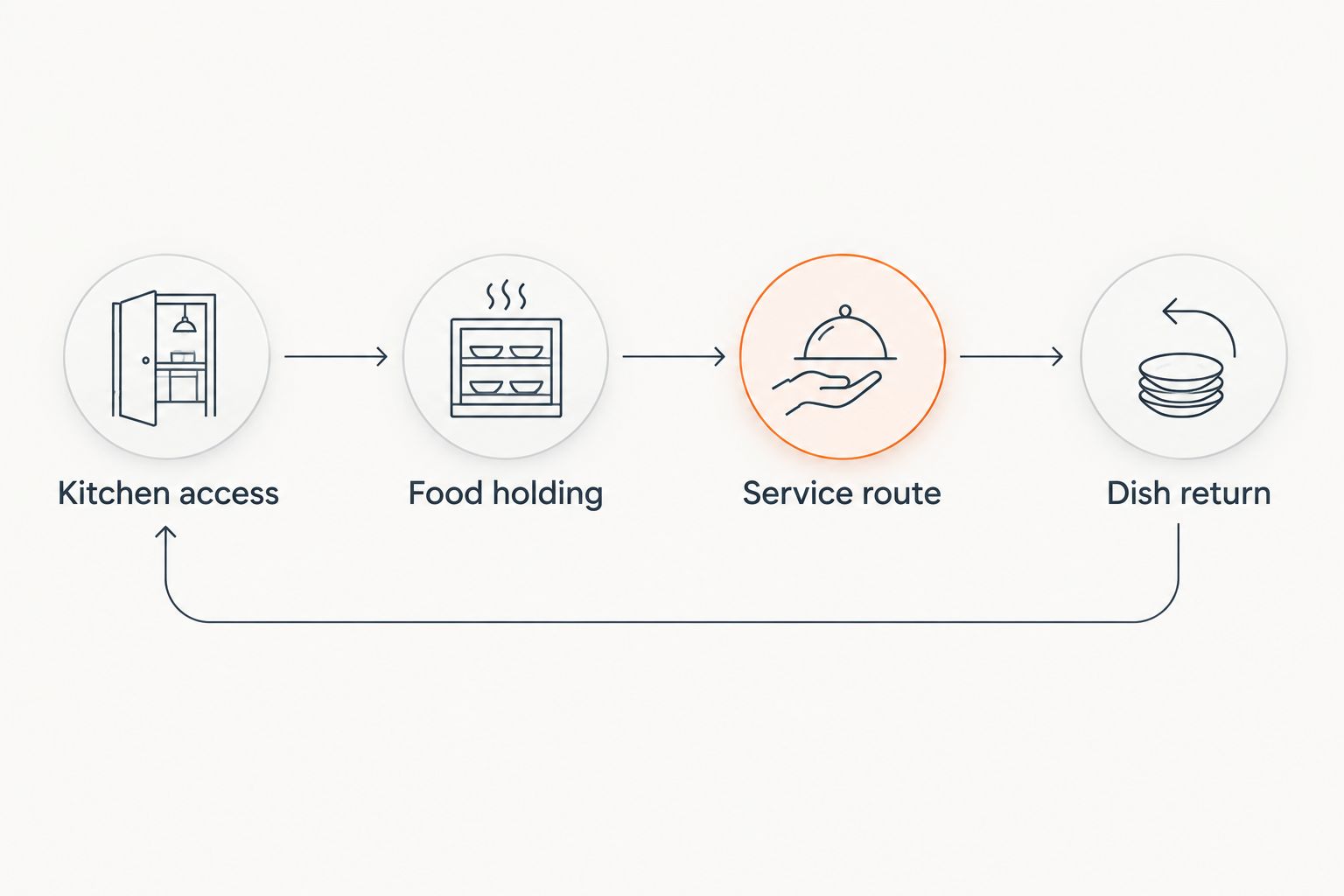
- Map service routes. On the floor plan, mark Kitchen access, Food holding, Service route, and Dish return. Ask the venue and caterer to review doorways, stairs, lifts, and any route that crosses guest areas.
- Build the service schedule. Tie kitchen activity to the ceremony, cocktail reception, dinner, speeches, and other planned transitions. Ask the catering team to confirm the sequence rather than choosing preparation times independently.
- Assign safety responsibilities. Identify who monitors receiving, storage, holding, dietary-meal identification, and any necessary reheating. Confirm the applicable local requirements with the catering team and venue.
- Close the cleanup plan. Record responsibility for washing up, packaging leftovers, removing waste, returning equipment, and restoring the kitchen. Obtain approval from both operational contacts.
Expected result: The floor plan, menu, service schedule, and cleanup responsibilities agree. Each contact holds the same approved version.
Include food safety in the handoff
The FDA Food Code provides a useful benchmark for your 2026 planning conversation: time/temperature control for safety foods generally require cold holding at 41°F or below or hot holding at 135°F or above. Local rules and permitted procedures govern the event; these figures are not a substitute for a caterer’s food-safety plan.
Ask who provides suitable holding equipment, who checks temperatures, and what happens if an appliance fails. Keep dietary-meal identification separate from general menu descriptions. A preference note alone does not establish an allergen-handling procedure.
Before approving the scope, use the guide to comparing complete wedding catering quotes to check that kitchen-dependent responsibilities appear in writing.
When the menu, guest count, or venue changes
The adjacent workflow is change control: repeat the relevant checks whenever an event detail changes. A revised menu is not just a document edit if it changes cooking, storage, staffing, or service needs.
For your 2026 wedding, keep a short Change record beside the approved plan:
- Describe the change. Record the new guest count, dish, service format, reception room, or access arrangement. State which earlier decision it replaces.
- Check the dependencies. Ask the catering and venue contacts to review equipment, holding space, staffing, routes, dietary handling, and cleanup implications.
- Approve the revision. Obtain written confirmation of the operational changes and any revised proposal before treating the new request as agreed.
- Replace outdated copies. Send the approved version to the planner and operational contacts. Label earlier copies as superseded so they do not guide wedding-day decisions.
Expected result: A change reaches everyone responsible for carrying it out. The venue does not plan from the original guest count while the catering team works from a later one.
Apply the same process to a weather-related room move. Confirm that the alternate space has an approved service route and suitable food-holding arrangements rather than assuming the original kitchen plan transfers unchanged.
Troubleshooting kitchen coordination
The venue has a kitchen but prohibits cooking
Ask the venue to define the permitted activities in writing. Then have the catering team assess a finishing, assembly, or service-staging approach. Do not solve the restriction by bringing cooking equipment without permission.
Refrigeration is shared with another event
Request a specific allocation of usable storage and confirm access times. If the venue cannot commit that space, ask the catering team to propose an approved alternative or revise the menu. Shared access is not reserved capacity.
Caterer arrival conflicts with venue access
Bring the venue and catering contacts into the same conversation. Confirm a workable access schedule, then check its effect on preparation and service. Do not preserve an arrival time that the venue has not authorized.
Different documents assign the same task differently
Create one responsibility list and have both parties approve it. Resolve equipment setup, dishwashing, waste removal, and kitchen restoration explicitly. A task appearing in two documents does not establish who performs it.
A dietary request arrives after menu approval
Send the request directly to the catering contact and ask for a handling assessment. Confirm any menu and identification changes in writing. Never promise a guest that a meal meets a medical dietary requirement without the catering team’s confirmation.
Customize your workflow
Use the approved kitchen plan to make your inquiry specific. Gabbeys provides wedding catering, private chef services, private parties, and meal prep; personalized menus and attentive service are the reasons to begin that conversation.
For a wedding inquiry, share the venue address, date, guest count, desired dining experience, dietary needs, and kitchen-use restrictions. Ask what the proposal includes and which responsibilities remain with the venue or another provider.
Cost depends on the agreed menu, guest count, staffing, service format, equipment needs, access conditions, and event scope. Request a personalized quote tied to the approved kitchen plan, not a menu description alone.
If you are also arranging a rehearsal dinner, private celebration, or recurring in-home meal prep, describe each need separately. Different occasions require their own access, preparation, and service arrangements.
Discuss your wedding catering plan
Share your venue, guest count, menu preferences, and kitchen restrictions for a personalized inquiry.
FAQ
How do I connect catering to my wedding venue kitchen?
Connect catering to your wedding venue kitchen by securing permission, confirming equipment and access, and approving one shared service plan. Give the venue and caterer direct operational contacts so kitchen decisions do not depend on messages relayed through you.
Can Gabbeys cater at any wedding venue in Dallas or Fort Worth?
Venue compatibility needs confirmation before you commit to a catering plan. Share the property address, outside-caterer policy, kitchen restrictions, and event details with Gabbeys so the proposed scope can be assessed.
What if my wedding venue only has a preparation kitchen?
Ask the venue exactly which activities the preparation kitchen permits. The catering team can then assess whether finishing, assembly, or service staging fits the proposed menu and approved facilities.
Who provides equipment for a wedding venue kitchen?
Equipment responsibility must be assigned in the written event scope. List what the venue permits you to use, what the caterer agrees to provide, and what requires a separate arrangement.
Should I choose my wedding menu before checking the kitchen?
Confirm the kitchen’s permitted use before finalizing your menu. You can share preferences earlier, but menu approval should follow the catering team’s review of preparation space, equipment, storage, and service conditions.
What happens if our wedding guest count changes?
Ask the venue and caterer to reassess the approved plan when the guest count changes. Confirm the effects on menu quantities, staffing, equipment, holding space, service timing, and the proposal before accepting the revision.
What should a wedding catering inquiry include?
Include the wedding date, venue address, estimated guest count, preferred service format, dietary needs, and kitchen-use rules. Add the reception schedule and venue contact so the discussion can address both your celebration and its practical requirements.
One last thing
The return journey deserves its own plan. Used plates, waste, and departing equipment still need a route after dinner service ends.
Before signing off your 2026 kitchen plan, ask: Who accepts the kitchen back, and what condition must it be in? Put the answer beside the departure schedule. A clear final handoff protects the evening’s closing moments from unfinished responsibilities.