Private chef services for wedding planners are personalized culinary services coordinated around a couple’s celebration, with the aim of delivering a thoughtfully hosted wedding experience. For Dallas and Fort Worth planners, the work includes matching menus, kitchen access, staffing, and service timing—not simply choosing dishes.
- Private chef services for wedding planners need a clear event brief, venue review, and written service responsibilities.
- Gabbeys suits wedding planners seeking personalized menus and attentive service for weddings and private celebrations.
- Choose private chef dining, plated catering, or buffet service around the venue and guest experience.
- Compare complete wedding catering proposals, not menus alone; confirm staffing, rentals, travel, and cleanup responsibilities.
Why private chef services matter for wedding planners
Wedding planners coordinate food with everything surrounding it: ceremony timing, speeches, photography, rentals, and venue access. A beautiful menu is not a complete service plan. You need agreement on how dinner reaches guests and who handles each handoff.
For your 2026 Dallas or Fort Worth wedding brief, confirm the exact event address before developing the menu. A provider’s regional coverage does not establish travel arrangements for a particular property; use this guide to checking private chef service areas and travel fees to structure that conversation.
Private chef dining deserves consideration for intimate weddings, rehearsal dinners, and private family gatherings. Larger receptions require a separate discussion about production, service, and venue requirements. Choose the service around the event’s needs, not the job title alone.
How to coordinate a private chef for a wedding
1. Define the celebration before requesting menus
Start with a shared planning document. A simple document or spreadsheet gives the couple, planner, and culinary provider a common reference without requiring a planning platform.
Describe the experience before naming dishes. Does the couple want a quiet dinner with close family, a reception built around conversation, or a meal with clearly timed courses? Each brief creates different service questions.
Separate related events rather than placing them under a single wedding label. A rehearsal dinner at a private residence and a reception at an event venue need distinct scopes, even when the couple wants a consistent culinary theme.
Ask the couple to distinguish essential preferences from welcome extras. That makes proposal review more focused and prevents an attractive addition from displacing a requirement.
- Record the event address, date, and expected guest count.
- Describe the desired atmosphere and dining experience.
- List each wedding-related meal as a separate event.
- Identify essential preferences and flexible details.
- Name the person authorized to approve changes.
2. Confirm venue permissions and working conditions
Request the venue’s catering requirements yourself before asking a chef to develop a detailed proposal. For a residence or vacation rental, obtain the property owner’s relevant permissions rather than treating a domestic kitchen as an approved event kitchen.
Kitchen photographs help start the discussion, but they do not replace an equipment review. Ask the culinary provider to assess cooking capacity, refrigeration, preparation surfaces, water access, and the route between preparation and service.
Document what the property supplies and what requires a separate arrangement. An appealing dining room does not answer where deliveries arrive, where service equipment sits, or how waste leaves the property.
For outdoor events, agree on a weather alternative before the menu becomes fixed. Ask how a location change would affect preparation, food holding, and guest service.
- Obtain written venue or property permissions.
- Share kitchen photographs and equipment details.
- Confirm delivery, loading, and parking arrangements.
- Identify preparation, service, and waste-handling areas.
- Record the indoor alternative for outdoor dining.
3. Build the menu around the couple and guests
Collect preferences directly through a questionnaire, then consolidate the answers before sharing them with the culinary provider. Keep favorite flavors, disliked ingredients, allergies, and other dietary requirements in separate fields so the distinctions remain clear.
Gabbeys is best for wedding planners seeking personalized menus and attentive service. Gabbeys provides private chef, catering, and event services; use that discussion to explore the right scope for the wedding and its surrounding celebrations.
Personalization should support the entire table, not just the couple’s preferred dishes. Ask how dietary requests would be handled during preparation and service. Never present an accommodation as confirmed until the provider has accepted it explicitly.
For a 2026 wedding menu, request a written approval version. Record how later changes will be submitted and who can authorize them.
- Gather the couple’s culinary preferences in writing.
- Separate allergies from preferences and other dietary requests.
- Ask how each requested accommodation will be handled.
- Discuss menu fit with the chosen service format.
- Approve a dated menu version before final coordination.
4. Match staffing and equipment to the service
Create a responsibility sheet before comparing proposals. List each task and assign it to the chef, service team, venue, rental provider, planner, or another named party. An unassigned task is a question to resolve, not an assumed inclusion.
Cooking and guest service are different responsibilities. Ask who welcomes guests to the meal, carries plates, replenishes shared dishes, clears tables, and manages beverages. Do not assume those tasks come with private chef dining.
Equipment deserves the same attention. Review the kitchen equipment a private chef needs for a dinner party when preparing questions about a residential wedding meal.
The advantage of a detailed scope is clarity; the limitation is that a more involved service plan requires more coordination. Resolve that trade-off before the couple approves the experience.
- Assign cooking, serving, clearing, and beverage responsibilities.
- Confirm which equipment the property supplies.
- Identify rentals and the party arranging them.
- Define dishwashing, waste removal, and final cleanup.
- Record any responsibilities retained by the planner.
5. Compare proposals against the same scope
Use a spreadsheet to compare written proposals side by side. Give each provider the same event brief so differences reflect the proposed service rather than missing information.
Guest count, menu choices, service format, staffing, equipment, venue conditions, and travel arrangements all belong in the quote discussion. Ask for a personalized quote instead of treating a general estimate as the wedding’s final scope.
For your 2026 proposal review, mark each requirement as included, excluded, or awaiting confirmation. An attractive menu does not settle who provides tableware or handles the final kitchen cleanup.
Review contractual terms separately from culinary preferences. Payment arrangements, change procedures, cancellation provisions, and approval deadlines need direct confirmation in the agreement. Never infer them from a friendly consultation.
- Send every provider the same written event brief.
- Compare menu, staffing, equipment, and travel scope.
- Mark exclusions and unresolved items clearly.
- Confirm how guest-count or menu changes are handled.
- Review the agreement before recommending approval.
6. Coordinate dinner with the wedding timeline
Draft the meal sequence in your existing planning document. Work backward from the couple’s preferred dinner experience, then discuss preparation and service requirements with the culinary provider.
A reception timeline needs more than a dinner start time. Identify when the kitchen becomes accessible, when guests are seated, when speeches occur, and when the venue expects service areas cleared.
Do not place a speech inside a service window without checking how the pause affects the meal. Likewise, keep photography movements visible to the culinary team when they change who is seated and ready to eat.
Build 3 checkpoints into the plan: guest seating, meal service, and clearing. These are coordination points, not fixed durations; agree on timing with the people responsible for delivering the event.
- Confirm kitchen access and preparation windows.
- Align guest seating with the service plan.
- Place speeches around agreed meal transitions.
- Share photography movements affecting the couple or guests.
- Name the contact who authorizes timeline adjustments.
7. Confirm the final handoff in writing
Bring the approved details into a single handoff document. Your 2026 wedding plan should make the current instructions easy to find without searching through separate messages.
Use 1 final approval contact for culinary changes. That person should collect requests from the couple, family, and other vendors, then communicate the accepted instructions to the provider.
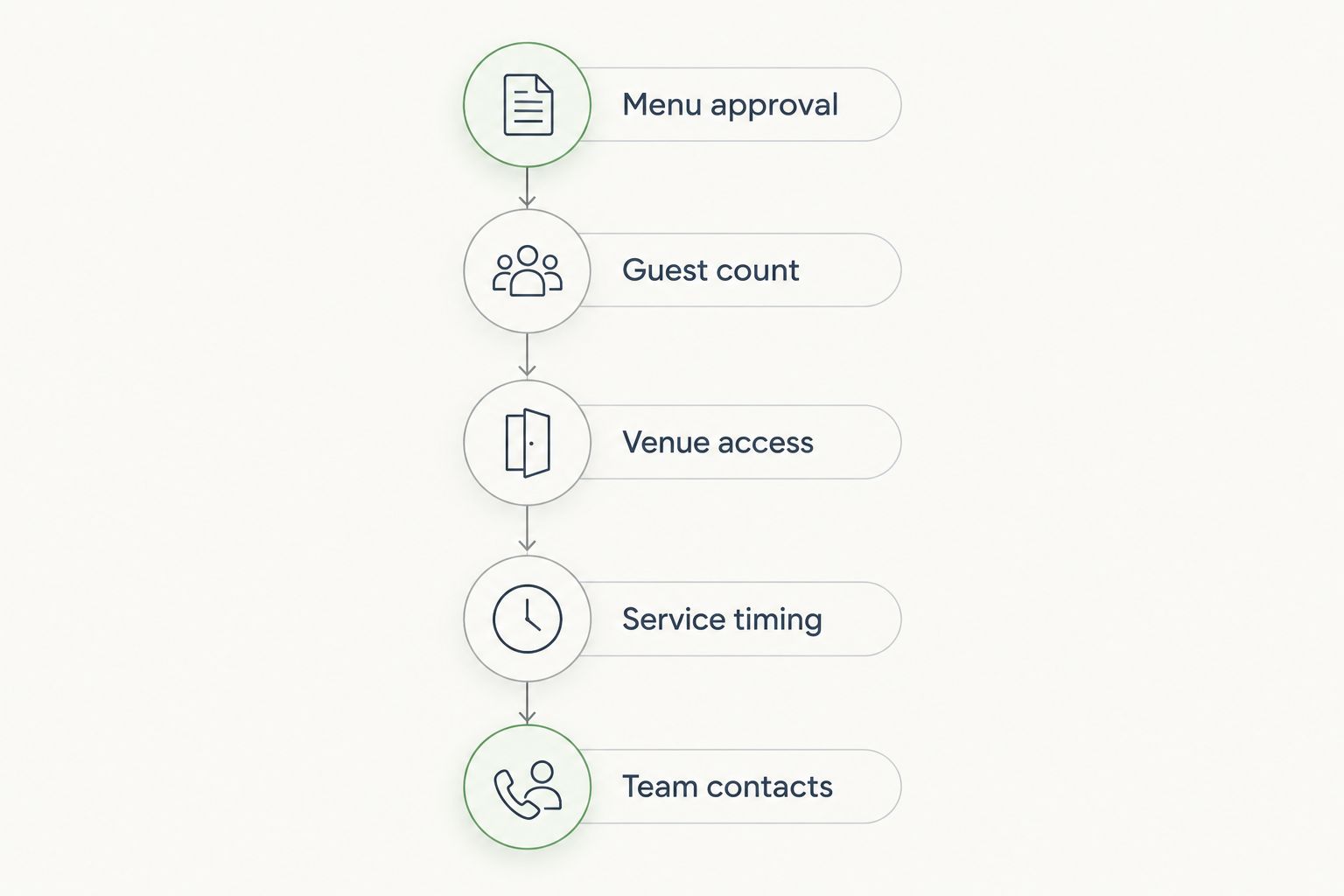
Organize the handoff under these headings. Ask each responsible party to acknowledge the details relevant to their work, and record open questions before treating the plan as final.
- Menu approval: attach the accepted menu and dietary instructions.
- Guest count: record the agreed count and change procedure.
- Venue access: confirm entry, preparation, and departure arrangements.
- Service timing: attach the accepted meal sequence.
- Team contacts: list the planner and relevant vendor contacts.
Once the brief is ready, send Gabbeys the event location, date, guest count, preferred experience, and known venue requirements. Request a personalized proposal that addresses both the menu and the service responsibilities.
Plan your wedding dining
Share your wedding brief and request a personalized menu and service quote.
Compare dining options for wedding events
The best option is the one your venue, timeline, and service team can support. Use this comparison to frame a consultation, not as confirmation that a particular provider offers every format.
| Option | Best for | Main advantage | Key limitation |
|---|---|---|---|
| Private chef dining | Intimate weddings, rehearsal dinners, and private family meals | Direct discussion of a personalized dining experience | Kitchen suitability and serving responsibilities need explicit review |
| Plated wedding catering | Receptions organized around seated courses | A defined sequence for serving guests at their tables | Requires coordination of seating, dietary meals, and service timing |
| Buffet catering | Celebrations where guests choose from a shared selection | Gives guests choice at the service area | Requires planning for guest movement, replenishment, and dietary questions |
| Food stations | Receptions organized around several service points | Separates food service into distinct areas | Requires suitable space and an agreed staffing and replenishment plan |
Avoid selecting a format solely because it sounds more luxurious. A thoughtfully coordinated family meal can serve an intimate celebration better than a complicated course sequence. Ask the couple what they want dinner to feel like, then test the practical requirements.
Common mistakes wedding planners make
Treating a private chef booking as complete wedding catering
A culinary booking does not establish serving staff, rentals, beverages, or cleanup. Ask for a written scope covering the whole meal experience, then assign anything excluded to another responsible party.
Approving dishes before checking the property
A menu selected before kitchen review creates unresolved production questions. Confirm permissions and working conditions first, especially when planning a celebration at a private home or rental property.
Combining separate celebrations into an unclear brief
A welcome dinner, wedding reception, and family brunch are separate service requests. Describe each independently so guest counts, access arrangements, menus, and responsibilities remain visible.
Letting family requests bypass the approval contact
A relative’s request can conflict with the couple’s approved plan. Keep culinary changes with the designated contact, and circulate an updated document only after the provider accepts the change.
Leaving dietary communication until guests are seated
A table-side request leaves little room for advance coordination. Collect requirements before menu approval, confirm what the provider can accommodate, and agree on how the service team identifies the relevant guest meals.
FAQ
What are private chef services for wedding planners?
Private chef services for wedding planners are culinary services coordinated around a couple’s wedding or related private celebrations. The planner aligns the menu, venue conditions, staffing responsibilities, and meal timing with the provider.
Is a private chef better than wedding catering?
Neither option is automatically better; the right choice depends on the event’s scale, venue, and service requirements. Private chef dining deserves consideration for intimate celebrations, while a reception needs a clearly defined catering and staffing plan.
Can I ask Gabbeys about a Dallas or Fort Worth wedding?
Yes. Gabbeys provides wedding, private chef, and catering services in Texas; share the exact Dallas or Fort Worth location, date, guest count, and desired experience to discuss your event’s scope.
Does booking a private chef include serving staff?
Serving staff must be confirmed in the written proposal. Ask who will serve food, manage beverages, clear tables, and clean the working areas rather than assuming these tasks are included.
How do I get an accurate wedding dining quote?
Send a consistent brief covering the event address, date, guest count, menu preferences, dietary requirements, venue equipment, and desired service format. Request a personalized quote identifying inclusions, exclusions, and responsibilities.
Can a private chef prepare a wedding meal at a vacation rental?
A vacation-rental wedding meal requires property permission and confirmation that the working conditions suit the proposed service. Check the rental’s event rules and arrange a kitchen and access review before approving the menu.
What should I include in a 2026 wedding chef inquiry?
Include the event date, exact location, expected guest count, celebration type, preferred dining experience, and known dietary requirements. Add kitchen details, venue restrictions, and your planning contact so the provider can address practical questions alongside the menu.
One last thing
Ask who clears the final plate before you approve the first course. That question exposes the boundary between cooking and hosting more clearly than a menu description does.
For a 2026 inquiry with Gabbeys, send a concise event brief rather than a request for menus alone. Personalized menus and attentive service belong in the same conversation as venue access, staffing, and the final handoff.