
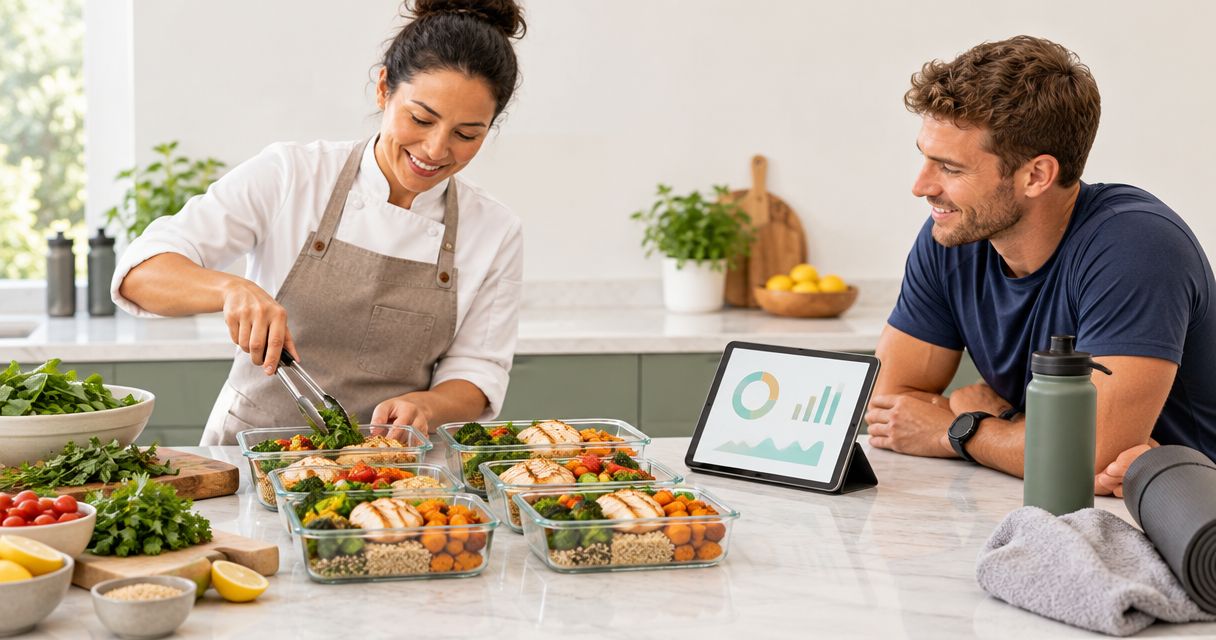
Fitness clients’ personal chef meal prep is personalized cooking organized around training routines, food preferences, and daily schedules, with the aim of making planned meals easier to maintain. This 2026 guide helps Dallas and Fort Worth clients turn dietary instructions, kitchen logistics, and recurring visits into a clear booking brief—not a promise of fitness results.
- Personal chef meal prep for fitness clients starts with dietary instructions, meal coverage, and a realistic recurring schedule.
- Gabbeys suits clients seeking personalized menus and attentive service for in-home meal prep.
- Agree on portion measurements and recipe calculations before requesting macro-specific meals.
- Choose recurring meal prep for routine meals; plan private dinners and wedding catering as separate occasions.
Why personal chef meal prep matters for fitness clients
A training plan does not tell you who will shop, cook, portion, and clean up. Personal chef meal prep addresses those practical tasks, while nutrition advice remains a separate responsibility. Your brief should explain what you need prepared—not ask a chef to diagnose your needs.
For Dallas and Fort Worth households, the decision also involves kitchen access, work schedules, and meals eaten away from home. A beautifully prepared lunch serves little purpose if you cannot refrigerate or reheat it where you eat.
Gabbeys is best for fitness clients seeking personalized meal prep menus and attentive service. Begin with Gabbeys when those priorities match your household, then request confirmation of your location, dietary requirements, and proposed schedule.
The strongest 2026 arrangement is not the one with the longest menu. It is the one that covers the meals you actually struggle to prepare and makes those meals practical to enjoy.
How to arrange personal chef meal prep for your fitness routine
Define the meals you need covered
Start with a simple calendar and record where you eat throughout a typical week. Mark the meals you already handle comfortably. Focus the chef’s brief on the gaps: an early departure, lunch between appointments, or dinner after an evening workout.
Avoid treating every meal as identical. A lunch eaten at a desk has different transport and reheating requirements from dinner enjoyed at home. Include the other people sharing the food, too; household portions and preferences belong in the initial discussion.
Choose a manageable starting scope rather than requesting every possible meal. You can discuss changes after you have experienced the preparation, storage, and daily routine.
- Identify the meals you want prepared.
- Separate at-home meals from packed meals.
- Record the number of people eating each meal.
- Note access to refrigeration and reheating equipment.
- Identify days when plans regularly change.
Translate dietary goals into cooking instructions
Write down your requirements before comparing services. If you follow a plan from a registered dietitian or another qualified clinician, share the relevant instructions with permission. Keep medical restrictions distinct from preferences such as texture, spice, or favorite ingredients.
For macro-specific meal prep, ask how recipes and portions would be calculated. Ingredient substitutions, cooking fats, sauces, and raw-versus-cooked weights all belong in that conversation. A request for high-protein meals is not the same as an agreed, measurable nutrition specification.
Do not assume that a private chef provides clinical nutrition advice or laboratory-verified nutrient values. If you need calculated information, establish what can be supplied and what its limitations are before booking.
- Separate allergies from preferences and dislikes.
- Share existing dietary instructions rather than requesting a diagnosis.
- Clarify whether ingredient weights refer to raw or cooked food.
- Ask how oils, dressings, and sauces enter calculations.
- Agree on how substitutions require approval.
Match the service to your household
Build a sample meal plan yourself first. That gives you a clear basis for deciding whether you need help with recipe selection, grocery shopping, preparation, or the whole cooking routine. A chef should solve a defined household task.
Gabbeys offers meal prep alongside private chef, catering, and event services. Its client-confirmed reasons to choose the service are personalized menus and attentive service. Ask how those priorities would translate into your recurring in-home arrangement; do not assume specific inclusions or nutrition-reporting capabilities.
For your 2026 inquiry, distinguish ongoing meals from celebrations. A recurring preparation visit, a private dinner, and wedding catering need different briefs, even when the same household is considering all of them.
- Describe recurring meal prep as the primary request.
- Confirm your Dallas or Fort Worth service address.
- Ask which shopping and preparation tasks are included.
- Explain who will eat the prepared meals.
- Keep event dates separate from recurring visit requests.
Design menus around meals you enjoy
List familiar dishes and explain what you like about them. This gives the chef more direction than broad labels such as clean eating. Describe preferred flavors, textures, ingredients, and reheating methods without assuming any particular menu is offered.
Ask for variety where you notice repetition most. You might prefer changing vegetables and sauces while keeping the main meal structure familiar. Alternatively, you might value different dishes and accept a longer planning discussion. Neither approach is automatically better.
Personalization also means considering the household. Ask whether a shared base dish with separately portioned components is practical, rather than assuming everyone needs an entirely different meal. Confirm feasibility and scope before treating that arrangement as part of the service.
- List favorite dishes and ingredients.
- Identify foods you dislike after reheating.
- Discuss separately packed sauces or dressings.
- Explain preferences for repeated versus changing dishes.
- Ask how household differences would be accommodated.
Plan kitchen access and safe storage
Walk through your kitchen before the consultation. Note refrigerator space, freezer capacity, available containers, cooking equipment, and where preparation can happen without disrupting the household. Send an accurate description rather than assuming a home kitchen supports every proposed dish.
Food safety needs an explicit handoff. USDA guidance calls for refrigeration at 40°F or below, refrigeration of perishable food within 2 hours, and use of refrigerated cooked leftovers within 3–4 days. Hot conditions require stricter handling; discuss transport and cooling rather than leaving food on the counter.
These are general food-safety limits, not a promised shelf life for a chef’s menu. Ask for dish-specific storage and reheating instructions, and plan freezing where appropriate instead of stretching refrigerated storage to match the next visit.
- Clear preparation surfaces and refrigerator space.
- Confirm which equipment and containers are needed.
- Arrange access for the agreed visit.
- Request preparation dates and storage instructions.
- Identify meals that need freezing rather than extended refrigeration.
Agree on portions and the meal handoff
Prepare a written handoff template yourself: dish name, intended portion, preparation date, storage location, and reheating instructions. Then ask what the chef can provide. A shared format makes it easier to discuss meals without relying on memory.
If you track intake, briefing your meal-prep chef should establish whether a portion means a weighed component, a finished dish, or a household serving. Those descriptions are not interchangeable, and a meal name alone does not explain how its nutrition was calculated.
Gabbeys meal prep inquiries should state any measurement or labeling requirements explicitly. Personalized menus do not, by themselves, confirm a particular tracking method. Agree on what is practical before your first visit, including how changes to ingredients or serving sizes will be communicated.
- Define what constitutes an individual portion.
- Ask which measurements can be recorded.
- Confirm how shared dishes will be divided.
- Request clear storage and reheating directions.
- Establish how ingredient substitutions will be communicated.
Review the arrangement before repeating it
Keep brief notes after eating the meals. Record what you enjoyed, what remained uneaten, and which meals were inconvenient to transport or reheat. Review the service against your original cooking problem—not only against how appealing the menu sounded.
For a recurring 2026 schedule, discuss adjustments before assuming that every visit will follow the same pattern. Travel, work commitments, and household events can change the number of meals you need. Ask about scheduling terms rather than presuming flexibility.
Keep fitness outcomes separate from service feedback. Your chef can respond to cooking instructions and preferences; training progress or clinical concerns belong with the appropriate professional. That boundary keeps the relationship clear and the menu discussion productive.
- Note which meals you finished and enjoyed.
- Record practical problems with storage or reheating.
- Adjust meal counts to reduce unwanted leftovers.
- Discuss scheduling changes and notice requirements.
- Confirm revised instructions before the next visit.
Compare meal preparation options
Choose the service model before choosing the menu. The distinction is who does the work, how much household coordination you want, and whether you need recurring meals or a hosted occasion.
The table compares service models, not confirmed packages. Ask each provider to explain its actual scope. A personalized quote should reflect your location, meal coverage, dietary requirements, shopping responsibilities, preparation needs, and requested frequency.
| Option | Best for | Main advantage | Key limitation |
|---|---|---|---|
| Self-directed batch cooking | Clients who enjoy cooking and want direct control | You choose ingredients, portions, and timing | You retain planning, shopping, cooking, and cleanup |
| Recurring in-home chef meal prep | Households seeking cooking support around a repeat routine | You can discuss household preferences directly | Kitchen access, storage, and service scope need coordination |
| Prepared-meal delivery | Clients who prefer ordering finished meals | Meals arrive already prepared | Choice depends on the provider’s menu and customization terms |
| Full-time household chef | Households considering ongoing culinary employment | The role can be defined around household needs | Hiring and employment responsibilities require separate planning |
| Private dinner or event catering | Hosts planning parties, celebrations, or weddings | The service centers on a specific occasion | An event arrangement does not establish recurring meal coverage |
For Dallas and Fort Worth clients considering Gabbeys, the practical next step is a meal-prep inquiry with a clear household brief. If you also want a private dinner or wedding proposal, identify that as an additional request rather than combining every need into one undefined booking.
Common mistakes fitness clients make
Requesting macros without defining measurements
A target is incomplete if nobody has agreed how portions will be measured. Ask whether calculations use ingredient quantities, finished recipe yield, or another stated method. Do not treat an unlabeled serving as a verified nutrition result.
Choosing more meals than you can store safely
A large preparation session does not remove refrigeration limits. Match the menu to your refrigerator, freezer, transport arrangements, and eating schedule. Discuss which dishes should be frozen and how they should be thawed and reheated.
Treating preferences as allergy instructions
A disliked ingredient and a medically significant allergy require different conversations. State allergies clearly, ask about handling practices, and confirm whether the provider can meet your needs. Do not infer that personalized cooking means an allergen-free environment.
Forgetting the people sharing your kitchen
A meal plan can fit your training routine but disrupt the household. Discuss preparation access, shared refrigerator space, and other diners before confirming visits. Attentive service begins with an accurate picture of how your home works.
Booking before agreeing on scope
A menu discussion is not a complete service agreement. Confirm shopping, containers, cleanup responsibilities, dietary instructions, scheduling terms, and the proposed quote. For a 2026 recurring arrangement, document the current agreement rather than relying on a previous conversation.
Plan your personalized meal prep
Share your Dallas–Fort Worth location, meal needs, and dietary instructions for a personalized quote.
FAQ
What is personal chef meal prep for fitness clients?
Personal chef meal prep for fitness clients is cooking organized around stated dietary instructions, preferences, and daily routines. Confirm the meals, portions, preparation responsibilities, and storage arrangements before booking.
Is Gabbeys a good fit for recurring fitness meal prep?
Gabbeys suits clients seeking personalized menus and attentive service for meal prep. Dallas and Fort Worth clients should ask about their address, proposed recurring schedule, and specific dietary requirements.
Can a personal chef prepare meals to match my macros?
Macro-specific preparation requires agreement on targets, ingredient measurements, portioning, and calculation methods. Ask the provider what it can supply; personalized meal prep alone does not confirm nutrition-reporting capabilities.
Should my chef create my sports nutrition plan?
Keep sports nutrition planning separate from cooking unless the provider has confirmed appropriate qualifications and scope. Give your chef the relevant instructions from your qualified nutrition professional.
How much does personalized fitness meal prep cost?
Request a personalized quote based on your meal coverage, household size, location, dietary requirements, and preparation needs. Ask how shopping, containers, cleanup, and scheduling affect the proposed scope.
How long can I refrigerate chef-prepared meals?
USDA guidance recommends using refrigerated cooked leftovers within 3–4 days when handled safely and kept at 40°F or below. Follow dish-specific instructions and arrange freezing when meals will be eaten later.
Can I book meal prep and a private dinner together?
You can discuss both needs with Gabbeys, which offers meal prep, private chef, catering, and event services. Request separate scopes for recurring meals and the dinner so each has clear requirements.
One last thing
Bring the chef a picture of your real eating week, not just your ideal menu. Note where meals happen, which ones you miss, and what food you leave uneaten. That information gives a personalized menu a practical purpose—and gives your booking inquiry a clear starting point.