
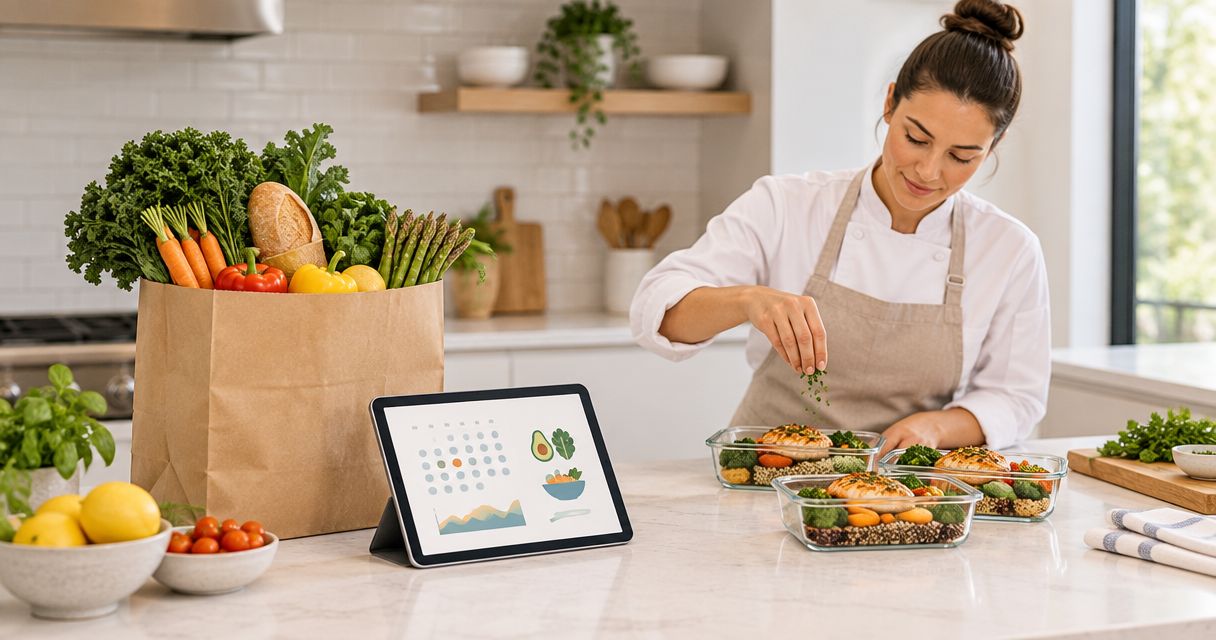
Instead of manually chasing grocery deliveries before every chef visit, connect your approved menu, grocery order, delivery window, and kitchen access in one shared schedule. For Dallas and Fort Worth households planning recurring meal prep in 2026, the essential rule is simple: groceries must be received, checked, and stored before cooking begins.
- A grocery delivery personal chef meal prep schedule starts with an approved menu, not a recurring shopping cart.
- Gabbeys is best for clients seeking personalized meal prep menus and attentive service.
- Assign one grocery purchaser and one receiving contact before placing an order.
- Confirm delivery and kitchen readiness separately; a delivery notification does not confirm ingredients are ready.
Why this matters
A chef appointment and a grocery delivery are separate commitments. Connecting them means deciding who approves ingredients, who handles substitutions, and who puts refrigerated food away—not simply choosing matching dates.
Gabbeys is best for clients seeking personalized meal prep menus and attentive service. For a recurring arrangement, discuss grocery responsibilities during the inquiry rather than assuming shopping or delivery coordination is included. The guide to who shops for personal chef meal prep groceries explains the decisions to settle first.
This is a shared-calendar and checklist workflow, not a claimed connection between a grocery platform and a chef booking system. You can follow it without giving anyone access to your payment account.
Before you start
- Confirm the service arrangement. Have a proposed chef visit, household meal requirements, dietary restrictions, and agreement about who purchases groceries. Ask whether client-ordered groceries fit the proposed service.
- Prepare your scheduling materials. Use a calendar or shared note, your delivery account if you are ordering, an approved ingredient list, and a receiving contact who can access the home.
- Resolve substitutions before checkout. A replacement can change allergens, quantities, or cooking requirements. Agree on approval responsibilities before the delivery shopper needs an answer.
Do not share grocery passwords or payment details to make coordination easier. Share the information needed for the visit: approved ingredients, delivery status, access instructions, and unresolved questions.
Grocery ownership
Choose the purchasing arrangement before building the schedule. These are planning options to discuss, not statements about what a particular service includes.
| Arrangement | Best for | Advantage | Limitation | Confirm before ordering |
|---|---|---|---|---|
| Client-managed delivery | Households that want control of their grocery account | You control checkout and see order changes directly | You must manage substitutions, receiving, and missing items | Whether the chef accepts client-supplied ingredients |
| Chef-managed purchasing, if offered | Households seeking fewer shopping tasks | Ingredient decisions can stay with the person planning the cooking | Scope and purchasing responsibilities require agreement | Whether purchasing is offered and how approval works |
Choose one purchasing owner for each visit. Two people ordering against the same menu can create duplicate ingredients while leaving less obvious items unpurchased.
Client-managed delivery offers direct control, but that control comes with administrative work. Personalized menus still depend on accurate quantities, acceptable substitutions, and ingredients arriving in usable condition.
Menu and ingredient approval
The following bold labels are suggested headings for your own shared note. They are not software buttons or settings.
- Create the visit record. Add Chef visit, Menu approval, Delivery window, and Receiving contact. Include the full date and year, such as your actual 2026 appointment date, so copied records remain clear.
- Document the household brief. State how many people will eat, which meals you need, relevant allergies, preferences, and any meals you intend to freeze. Separate medical restrictions from preferences.
- Request ingredient confirmation. Ask the chef to confirm ingredients and quantities before you place the order. Do not convert a dish name into your own shopping list without agreement.
- Check existing supplies. Record what is already in the kitchen, including usable quantities and relevant package labels. Ask whether those supplies fit the approved menu.
- Set the substitution rule. Under Substitution approval, name the person who can approve replacements. Identify ingredients that require review rather than accepting whatever replacement is suggested.
Expected result: You have one approved ingredient list and a named person responsible for changes. Everyone is working from the same menu.
Keep preferences specific enough to act on. A request to avoid a particular ingredient gives clearer direction than a broad description such as eating clean. For allergies, provide accurate details and discuss handling requirements directly; a shopping note alone is not an allergy-management plan.
Delivery and kitchen access
Schedule receipt around the kitchen's readiness, not just the chef's arrival. A bag at the door is not the same as ingredients checked and refrigerated.
- Confirm the cooking appointment. Record when the kitchen must be accessible and ready. Include building entry, parking instructions where relevant, pets, and any household activity that affects kitchen use.
- Choose a workable delivery window. Select a window that allows someone to receive, inspect, and store the order before cooking. Ask the chef what timing the planned menu requires; do not invent a universal buffer.
- Assign the receiver. Put a name and contact method under Receiving contact. If nobody can receive groceries safely, change the delivery arrangement before placing the order.
- Enter delivery instructions. Give accurate address and entry details in the delivery service's available instruction field. Do not place sensitive home-access information in broadly shared calendar invitations.
- Prepare the kitchen. Clear working surfaces and make room in the refrigerator. Confirm which cooking equipment and storage containers are needed rather than assuming they are provided.
Expected result: A specific person can receive the order, store it safely, and make the kitchen accessible before the chef starts.
For recurring visits in 2026, treat the calendar entry as a coordination record, not proof of a confirmed booking. Changes to the calendar still need acknowledgment from the people affected.
Order review and receiving
Check the order against the approved ingredients, not only against the delivery receipt. A correctly delivered replacement can still be wrong for your menu.
- Review before checkout. Compare ingredient quantities, package sizes, and substitution instructions with the approved list. Check whether pantry items are actually present rather than relying on an old inventory.
- Record the order status. Add the expected delivery window and relevant order reference to the shared note. Keep payment information private.
- Inspect on receipt. Check missing items, substitutions, packaging condition, and whether refrigerated food has remained cold. Record unresolved issues under Ingredient exceptions.
- Store perishables promptly. Keep the refrigerator at 40°F or below. USDA food-safety guidance calls for refrigerating perishables within 2 hours, or within 1 hour when temperatures exceed 90°F.
- Send a readiness update. Confirm what arrived, what changed, and what needs a decision. Ask the chef to approve any menu adjustment before assuming the original cooking plan still works.
Expected result: Ingredients are stored, exceptions are visible, and the chef knows whether the approved menu can proceed.
For Dallas and Fort Worth households, use the shorter food-safety limit whenever outdoor temperatures exceed 90°F. Do not treat that limit as a delivery target; arrange prompt receipt and refrigeration.
A delivery notification confirms a delivery event, not ingredient suitability. Keep the readiness update separate so the chef does not have to infer whether someone brought the bags inside.
Repeat the workflow when the menu changes
A recurring appointment is useful; an unchanged grocery order is not always suitable. Repeat the approval sequence whenever meals, quantities, restrictions, or attendance change.
- Copy the previous visit record into a new dated entry.
- Reconfirm the household's meals and portions for that visit.
- Review remaining ingredients and prepared food before creating the next order.
- Obtain approval for the revised list, then place or update the order.
- Reconfirm the delivery receiver and kitchen access.
Best for recurring meal prep: Repeat the checklist, not an unreviewed cart. This preserves a familiar routine while allowing the menu to reflect your household's actual week.
For a 2026 travel week, school break, or changing work schedule, update the meal requirements before shopping. If fewer people will be home, the purchasing decision belongs before checkout—not after ingredients arrive.
Private dinners and celebration weeks
The same sequence also works when a private dinner replaces a routine meal prep visit. Start with the event menu and guest requirements, then confirm purchasing responsibilities and kitchen access again.
Do not carry ordinary meal prep assumptions into a party or wedding. Event timing, venue rules, service requirements, and equipment need their own agreement. An approved grocery list does not confirm the rest of an event's arrangements.
Troubleshooting
The delivery window overlaps the chef's arrival
Contact the chef and delivery provider as soon as the overlap becomes clear. Ask whether delivery can move or whether the cooking plan needs revision; do not assume the chef can wait or begin without essential ingredients.
For the next visit, schedule around receipt and storage rather than doorstep arrival. Keep the receiver's availability visible beside the delivery window.
A replacement conflicts with dietary requirements
Set the replacement aside and share its label information with the person responsible for approval. Do not serve it on the assumption that similar packaging or a familiar product name means equivalent ingredients.
Update substitution instructions before the next order. For an allergy concern, resolve suitability directly with the chef before cooking proceeds.
Essential ingredients are missing
Send a precise list of what is missing and what is already available. Ask the chef to choose between an approved menu adjustment and an additional purchasing plan.
Avoid independently ordering replacements while someone else is shopping. Assign the follow-up purchase to one person and record the decision.
Nobody can receive the groceries
Change the delivery time or arrange an agreed receiver with home access. Do not leave refrigerated ingredients unattended while waiting for the chef's appointment.
If perishables have exceeded safe time or temperature limits, do not rely on smell or appearance to establish safety. Resolve the ingredient issue before preparation.
The calendar changes but the order does not
Review the booking, grocery order, and receiving arrangements separately. Moving a calendar entry does not automatically reschedule an external delivery or confirm a chef's revised appointment.
Add Change acknowledged to your shared note and record which parties have responded. Leave the change unresolved until the relevant confirmations arrive.
Customize your workflow
For a qualified Gabbeys meal prep inquiry, describe your Dallas or Fort Worth location, preferred recurrence, household size, dietary requirements, and proposed grocery arrangement. Explain whether you want routine household meals, a private dinner, or separate event service.
Ask Gabbeys to clarify the proposed service scope before you build the delivery schedule. Personalized menus and attentive service are reasons to inquire; grocery purchasing and delivery coordination still require confirmation.
For your 2026 planning, request a personalized quote based on the actual brief. Meal requirements, preparation complexity, visit frequency, purchasing responsibilities, and any event-specific needs are details to discuss—not reasons to assume a standard package.
Use Gabbeys to begin that conversation. Include your scheduling constraints so the proposed arrangement addresses how your household operates, not just what you would like to eat.
Plan Your Recurring Meal Prep
Share your Dallas or Fort Worth location, menu needs, and preferred visit schedule.
FAQ
How do I create a grocery delivery personal chef meal prep schedule?
Approve the menu, assign grocery purchasing, and schedule delivery so someone can receive and store ingredients before cooking begins. Keep the chef appointment, delivery window, and readiness confirmation in one shared record.
Should groceries arrive before my personal chef?
Schedule groceries to be received, checked, and stored before the planned cooking begins. Ask your chef what timing the menu requires instead of assuming a universal delivery buffer.
Does Gabbeys order groceries for meal prep clients?
Confirm grocery purchasing responsibilities directly with Gabbeys before ordering. Your proposed service arrangement should identify who purchases ingredients, approves substitutions, and receives deliveries.
Can I reuse the same grocery order every week?
Reuse a grocery order only after checking it against the approved menu and your current kitchen supplies. Changing portions, dietary needs, or household attendance can make the previous order unsuitable.
What should I do if grocery delivery is late?
Tell the chef promptly and confirm whether the cooking plan or appointment needs to change. Do not assume the chef can wait or prepare the approved menu without essential ingredients.
Can grocery substitutions affect a personal chef menu?
Yes, substitutions can change allergens, quantities, and cooking requirements. Obtain approval for relevant replacements before treating the order as ready for preparation.
How do I request a meal prep quote for my household?
Share your location, household size, dietary requirements, preferred visit frequency, and grocery purchasing preferences. Request a personalized quote that explains the proposed scope and responsibilities.
One last thing
The most useful calendar status is not delivered. It is ready to cook. That status means someone checked the ingredients, stored perishables, resolved substitutions, and confirmed kitchen access.
Add that final checkpoint to your next visit record. It turns several separate arrangements into a clear handoff without pretending that a calendar can verify the kitchen for you.