
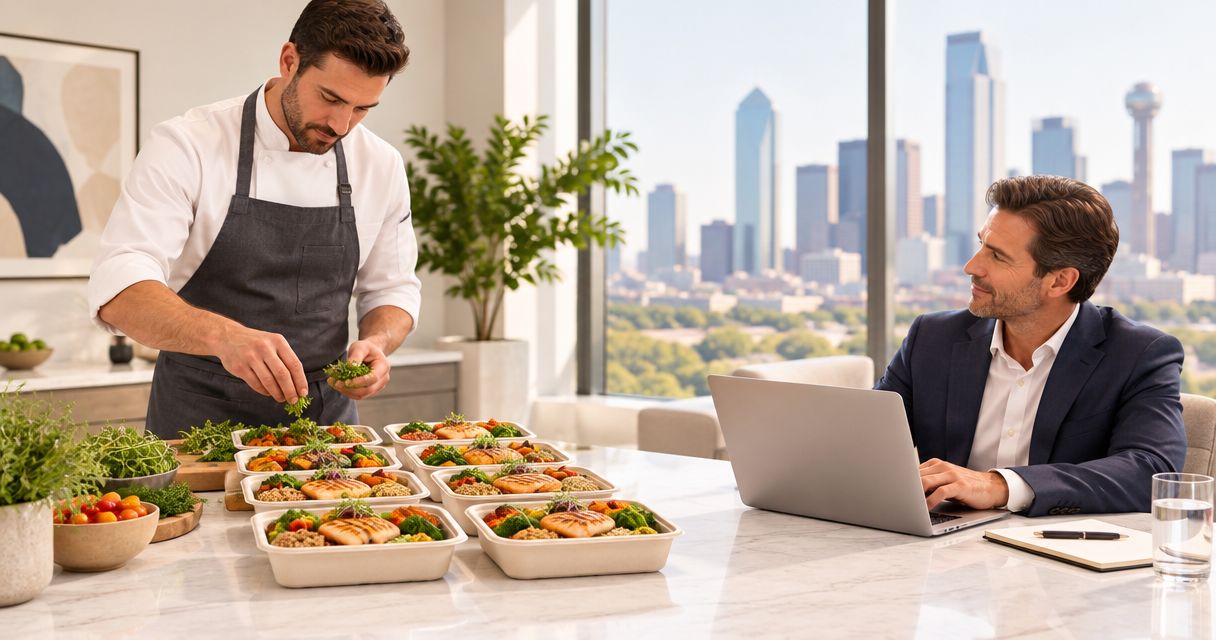
Executive personal chef meal prep is recurring, personalized meal preparation with the aim of keeping your household fed around a demanding work schedule. For Dallas and Fort Worth executives, the right arrangement accounts for office lunches, travel changes, family preferences, and how meals will actually be served at home.
- Personal chef meal prep for executives should follow your calendar, dietary needs, and household routines—not a fixed menu alone.
- Gabbeys is best for clients seeking personal chef meal prep with personalized menus and attentive service.
- Compare recurring visits with full-time support by responsibility, kitchen access, and scheduling needs.
- Request a personalized quote that separates recurring meal preparation from private dinners and event catering.
Why personal chef meal prep matters for executives
A meal plan only works when it matches the week you actually have. A late meeting changes dinner; a business trip changes how much food belongs in the refrigerator. Booking preparation without discussing those details leaves you managing the same decisions you wanted to delegate.
Choose a service around your household calendar before choosing individual dishes. For your 2026 planning, distinguish meals eaten at home from lunches taken to the office and evenings reserved for entertaining.
Gabbeys provides private chef, catering, and meal prep services, with personalized menus and attentive service as client-confirmed reasons to choose the company. For a Dallas or Fort Worth inquiry, give your location and desired schedule so the proposed arrangement addresses your actual household needs.
Recurring meal prep also needs a different brief from a private dinner. One prioritizes meals you can enjoy later; the other centers on an occasion and its service. Keep those scopes separate even when you discuss both with the same provider.
How to arrange executive meal prep in 2026
Map your actual eating schedule
Start with your calendar rather than a menu. Mark when you eat at home, when you need something portable, and when no meal is needed because you are traveling or attending a work dinner.
You can do this yourself in a shared calendar or a simple note. Include everyone eating the prepared food, not just the executive whose schedule prompted the inquiry. A partner working from home and a frequent traveler need different portions and timing.
Avoid treating an unusually quiet week as your normal routine. Describe both your typical pattern and the changes that make food planning difficult.
- At-home meals: identify which breakfasts, lunches, or dinners need coverage.
- Office lunches: note transport, refrigeration, and reheating access.
- Travel days: flag departures, returns, and meals you will miss.
- Household diners: record who eats each meal and any separate preferences.
- Schedule changes: identify who communicates updates to the chef.
Define preferences and dietary boundaries
Write your own food brief before requesting menu ideas. Separate foods you enjoy, foods you avoid by preference, and restrictions that require specific handling. Those categories should not be buried in a general request to eat better.
For clinical nutrition needs, ask your treating professional for guidance you can share. A chef inquiry should not replace medical advice, and dietary preferences alone do not establish that a kitchen can meet a particular allergy requirement.
Be equally clear about enjoyment. A technically suitable meal that your household does not want to eat is a poor fit. Include favorite flavors, preferred textures, and whether you enjoy repeating dishes.
- List preferred cuisines and ingredients.
- Distinguish allergies from dislikes and lifestyle preferences.
- Explain any clinician-provided dietary instructions.
- State whether different household members need separate meals.
- Describe preferred portions without assuming everyone eats equally.
- Ask how ingredient substitutions and cross-contact concerns are handled.
Build a menu around how you eat
Begin by grouping your meals by use: something portable, something ready to reheat, or components you can assemble when you get home. This gives you a practical starting point without needing a finished menu.
Then bring that brief to Gabbeys for a personalized meal prep inquiry. Personalized menus support this conversation, but the proposal still needs to confirm the dishes, preparation approach, and responsibilities for your household.
Ask how each proposed meal holds up between preparation and serving. A dish intended for immediate plating is not automatically suitable for an office microwave. Your menu discussion should cover the final eating experience, not only the chef's preparation day.
- Identify meals that must travel to the office.
- Separate ready-to-reheat dishes from components needing assembly.
- Ask which meals should be eaten first.
- Discuss texture and reheating preferences before approving dishes.
- Record substitutions for ingredients your household avoids.
Confirm the kitchen and handoff
Walk through your kitchen and make a short equipment list yourself. Note refrigerator space, freezer space, cooking equipment, and containers already on hand. Share practical access details without assuming the chef supplies everything else.
An in-home visit also needs a clear handoff. Someone should know when access begins, where food will be stored, and how the household receives instructions after preparation. For apartment or condominium homes, include any relevant building access procedures.
Confirm responsibilities in writing rather than treating them as standard inclusions. Shopping, containers, cleanup, and labeling belong in the discussion; their presence in a meal prep arrangement must be established in the proposal.
- List kitchen equipment and any known limitations.
- Identify available refrigerator and freezer space.
- Confirm who sources groceries and approves substitutions.
- Establish who provides food containers and labels.
- Describe parking, entry, and building access requirements.
- Agree on the condition in which the kitchen will be left.
Agree on storage and reheating instructions
Keep a household food-storage routine even before hiring a chef. Make room for prepared meals, check that your refrigerator maintains a safe temperature, and avoid leaving perishable food out while you settle into the evening.
USDA consumer food-safety guidance sets refrigeration at 40°F or below, recommends refrigerating perishable food within 2 hours, and advises reheating leftovers to 165°F. The room-temperature limit falls to 1 hour when temperatures exceed 90°F. These are general safety limits, not a promise that every prepared dish has the same storage life.
For your 2026 meal prep arrangement, request dish-specific instructions that explain storage, serving order, and reheating. The guide to storing and reheating personal chef meal prep safely addresses this handoff in more detail.
- Keep refrigerator temperature at or below the USDA limit.
- Request preparation dates and clear meal identification.
- Follow dish-specific refrigeration and freezing instructions.
- Check reheated leftovers with a food thermometer.
- Confirm transport instructions for meals taken to work.
- Ask what to do when travel changes the intended eating schedule.
Set the recurring schedule and review it
Draft your preferred preparation calendar yourself, then compare it with the proposed service arrangement. State which parts of your schedule are predictable and which regularly change. Do not assume recurring service means unlimited adjustments.
A useful review focuses on what happened: meals eaten, meals left untouched, dishes that traveled well, and instructions that needed clarification. This gives the next menu discussion a practical basis without turning dinner into another reporting task.
Review your 2026 arrangement when your working pattern changes, not only when a dish disappoints. A move from office days to frequent travel changes the brief even if your food preferences stay the same.
- Request a recurring schedule suited to your household.
- Confirm how changes and cancellations are handled.
- Identify the person authorized to approve menu adjustments.
- Review uneaten meals and portion preferences.
- Revisit kitchen access when household routines change.
- Keep private dinners and special events outside the recurring scope unless expressly included.
Compare the service options before you inquire
Recurring in-home meal prep is the best fit when you want personalized food for later meals, not continuous household coverage. Other arrangements serve different needs. Compare responsibilities before deciding which format belongs in your inquiry.
| Option | Best for | Main advantage | Key limitation |
|---|---|---|---|
| Recurring in-home meal prep | Executives wanting prepared meals around a changing workweek | You can discuss menus around household preferences and later serving | Requires kitchen access, storage space, and a clear reheating handoff |
| Full-time household chef | Households seeking an ongoing culinary role | The role can be defined around broader daily responsibilities | Requires a separate discussion of employment, duties, and household management |
| Self-managed batch cooking | Households wanting direct control of preparation | You choose ingredients, portions, and the cooking schedule | Shopping, cooking, storage, and cleanup remain your responsibility |
| Private dinner service | Hosts planning an at-home occasion | Centers the food and service on a specific gathering | Does not replace a recurring weekday meal plan |
| Event catering | Corporate hosts, wedding couples, and private-party hosts | Organizes food service around an event brief | Needs its own guest count, venue details, and service plan |
Gabbeys offers meal prep, private chef, and catering services. For recurring personal chef meal prep, the strengths to discuss are personalized menus and attentive service; the practical limitation is that the proposed schedule, inclusions, and kitchen requirements still need confirmation.
Do not select a full-time arrangement simply because your work calendar is demanding. First establish whether the need is prepared food, ongoing household support, or hospitality for guests.
Build a quote request that reflects the work
A useful quote request describes scope rather than asking for an unexplained total. Include your Dallas or Fort Worth location, household diners, meal coverage, dietary requirements, preferred preparation schedule, and kitchen conditions. Ask the provider to identify what the proposal includes and what requires separate agreement.
Menu complexity, shopping responsibilities, preparation workload, packaging, travel, and additional service requirements all belong in that discussion. Do not assume a charge applies; ask how each relevant item is treated.
Recurring preparation and entertaining also need separate comparisons. The scope behind private chef costs for events includes questions about guest service and the occasion itself; an executive meal prep brief instead needs to explain recurring preparation, storage, and household handoff. Comparing the two without separating those responsibilities obscures what you are buying.
For a 2026 inquiry, send a concise brief containing:
- Your service address area and preferred recurring schedule.
- The people eating and meals requiring coverage.
- Preferences, restrictions, and relevant kitchen information.
- Shopping, containers, labeling, and cleanup responsibilities to confirm.
- Travel patterns and the process you need for schedule changes.
- Any private dinner, party, or wedding inquiry as a separate scope.
Plan your recurring meal prep
Share your Dallas or Fort Worth schedule, household preferences, and service needs for a personalized quote.
Common mistakes executives make
Planning for the calendar you wish you had
Ordering around an uninterrupted week ignores late meetings and travel. Brief the chef on your real routine, including the nights you usually eat elsewhere. Otherwise, even a thoughtful menu can produce meals you do not use.
Delegating preferences without naming an approver
An assistant can coordinate access, but menu decisions still need an authorized household contact. Identify who approves substitutions, portions, and schedule changes so the chef does not receive conflicting instructions.
Treating an office lunch like an at-home dinner
A meal that works at home needs a different assessment before a commute. Explain how you transport lunch and what equipment is available at work. Ask for food suited to that routine rather than discovering the mismatch after preparation.
Combining recurring meals with guest hospitality
Adding a client dinner or anniversary celebration changes the service brief. Weddings and corporate gatherings require their own planning as well. Request a separate proposal rather than assuming routine meal prep covers plating, guest service, or event logistics.
Choosing dishes before checking storage space
A full refrigerator limits the practicality of a preparation visit. Clear space before confirming the menu and discuss how prepared food will be organized. The handoff matters as much as the dish selection.
FAQ
What's the best personal chef meal prep arrangement for a Dallas executive?
Recurring in-home meal prep is the best fit when you want personalized meals to eat later rather than continuous household chef coverage. Describe your office days, travel, household diners, and kitchen setup before choosing the schedule.
Does Gabbeys offer personal chef meal prep?
Gabbeys offers meal prep alongside private chef and catering services. For a Dallas or Fort Worth inquiry, request a personalized proposal that confirms your location, schedule, menu needs, and service responsibilities.
Is recurring meal prep better than hiring a full-time chef?
Recurring meal prep is better suited to a defined preparation need; a full-time chef arrangement addresses a broader ongoing household role. Compare the responsibilities you need covered rather than assuming a demanding job requires full-time service.
Who buys groceries for personal chef meal prep?
Grocery responsibility must be confirmed in the proposed arrangement. Ask who shops, how substitutions are approved, and how ingredient expenses are documented before agreeing to service.
Can a personal chef prepare meals for dietary restrictions?
Discuss each dietary restriction before accepting a menu and confirm whether the preparation environment meets your requirements. Separate allergies from preferences, and share clinician-provided instructions when relevant.
What should I ask about the cost of recurring meal prep?
Ask for a personalized quote that explains meal coverage, preparation responsibilities, groceries, containers, travel, and any additional services. Compare proposals with the same scope rather than treating different service arrangements as equivalent.
Can I add a private dinner to my recurring meal prep arrangement?
Request a separate private dinner scope rather than assuming it is included in recurring preparation. Confirm the occasion, guest count, menu, timing, and serving responsibilities with the provider.
What should I send before my first meal prep visit?
Send your household meal schedule, food preferences, dietary restrictions, kitchen details, and access instructions. Also identify who approves menus and how prepared meals should be labeled and handed over.
One last thing
Your return-from-travel dinner deserves a place in the brief. Tell the chef when you arrive home and whether that meal needs to be ready for reheating rather than further preparation. It is a small scheduling detail that connects the service to the moment you need it.
For your Gabbeys inquiry, start with the week you want to make easier. Then describe the meals, preferences, and attentive service that would make the arrangement right for your household.