
Yes, corporate event catering can serve 100 or more guests when the menu, staffing, venue facilities, and service schedule are planned together. Headcount alone does not confirm a caterer’s capacity; you also need written agreement on the service format, dietary arrangements, setup, and cleanup. For a Dallas or Fort Worth event in 2026, confirm those details before approving the booking.
- Corporate event catering 100 guests requires a confirmed service plan, not just enough food.
- Choose buffet, plated service, or stations around your event schedule and venue layout.
- Gabbeys corporate event catering emphasizes personalized menus and attentive service; confirm capacity for your specific event.
- Request a personalized quote covering food, staffing, equipment, setup, and cleanup responsibilities.
Can corporate event catering handle 100 or more guests?
Yes. The deciding question is whether the caterer can support your specific event—not whether catering generally works for 100 guests. A seated client dinner, an employee celebration, and a conference lunch require different arrangements even when attendance is identical.
For prospective Dallas and Fort Worth clients, Gabbeys offers corporate catering with personalized menus and attentive service. Ask for confirmation of your date, location, guest count, and requested format rather than treating a general service description as a capacity guarantee.
Use this sequence before choosing a menu:
- Define attendance. Separate confirmed attendees from invitations, and identify whether everyone eats together.
- Confirm the venue. Share the address, food-service rules, preparation facilities, and delivery access.
- Set the schedule. Identify when guests arrive, when food must be served, and when the room must be cleared.
- Choose the format. Match the dining experience to the agenda, seating, and available circulation space.
- Approve the scope. Put staffing, equipment, dietary arrangements, and cleanup responsibilities in writing.
A complete proposal connects these decisions. A menu alone does not establish that the event is ready to proceed.
Why this matters
Your guests experience catering as part of the event, not as a separate delivery. A queue that interrupts a presentation or a meal that arrives before guests are seated affects the occasion even when the food itself is thoughtfully prepared.
For your 2026 event, begin with the experience you want: uninterrupted conversation, a relaxed employee gathering, or a meal fitted between conference sessions. That decision gives the caterer a clear brief and helps you compare proposals on the same basis.
Plan the service around the occasion, then shape the menu around the service. This keeps hospitality central without overlooking the practical details that make guests comfortable.
Which service format fits 100 guests?
No format is automatically best for a large group. Choose according to your agenda and venue, then ask the caterer to explain how guests will receive their meals.
| Service format | Best for | Main advantage | Main limitation | What to confirm |
|---|---|---|---|---|
| Buffet | Employee gatherings with flexible meal timing | Guests can choose from the dishes presented | Queues need space and active management | Serving layout, replenishment, and dietary identification |
| Plated service | Seated client dinners and formal presentations | Guests remain seated during meal service | Meal choices and seating require coordination | Guest selections, table plan, and serving sequence |
| Food stations | Receptions built around movement and conversation | Food can be distributed across the event space | Popular stations can become gathering points | Station locations, staffing, and access routes |
| Individually packaged meals | Meetings where meals must be distributed around an agenda | Meals can be assigned and handed out individually | Less emphasis on a shared dining presentation | Labeling, distribution, and waste collection |
These are formats to discuss, not confirmed inclusions in any particular booking. Ask which options the provider can support at your venue.
Buffet service: best for flexible gatherings
A buffet gives guests choice without requiring individual table service. It also needs a clear approach, room to move away from the serving area, and a plan for replenishment.
Ask how the proposed layout handles guests arriving together. Do not assume that adding more food resolves a queue caused by the room arrangement.
Plated service: best for seated hospitality
Plated service suits an event where you want guests to remain at their tables. It supports conversation and a defined dining sequence, but it depends on accurate meal selections and coordinated service.
Confirm how dietary meals will reach the correct guests. If presentations continue during dinner, agree on when servers can enter and clear the room.
Stations: best for a reception atmosphere
Stations suit gatherings where guests are expected to move and mingle. Their success depends on placement: food service should not block registration, exits, or the route to seating.
Ask whether dishes are served by staff or collected by guests. That distinction affects how each station operates and what support belongs in the proposal.
Why catering plans vary for larger groups
For a 2026 inquiry, request a personalized quote rather than applying an assumed per-person figure. The proposal should reflect the event you are actually hosting.
These factors belong in the discussion:
- Guest count and arrival pattern. Serving 100 guests together requires a different plan from serving the same attendance across separate meal periods.
- Menu and dietary needs. Preparation, portioning, substitutions, and separate meal handling affect the work involved.
- Service format. Buffet, plated, and station service create different staffing and equipment requirements.
- Venue facilities. Preparation space, refrigeration, power, water, and loading access influence how service is organized.
- Event duration. A reception and an all-day conference need different schedules for food, staffing, and clearing.
- Scope of responsibility. Confirm who supplies tableware, serving equipment, rentals, setup, and cleanup rather than assuming these are included.
Ask the caterer to explain how each relevant factor appears in the quote. You should be able to distinguish food preparation from service responsibilities without interpreting vague package language.
What should you send with your catering inquiry?
A qualified inquiry makes the next conversation more useful. For a Dallas or Fort Worth event, provide the actual venue location rather than only the city; access arrangements and venue rules belong in the planning discussion.
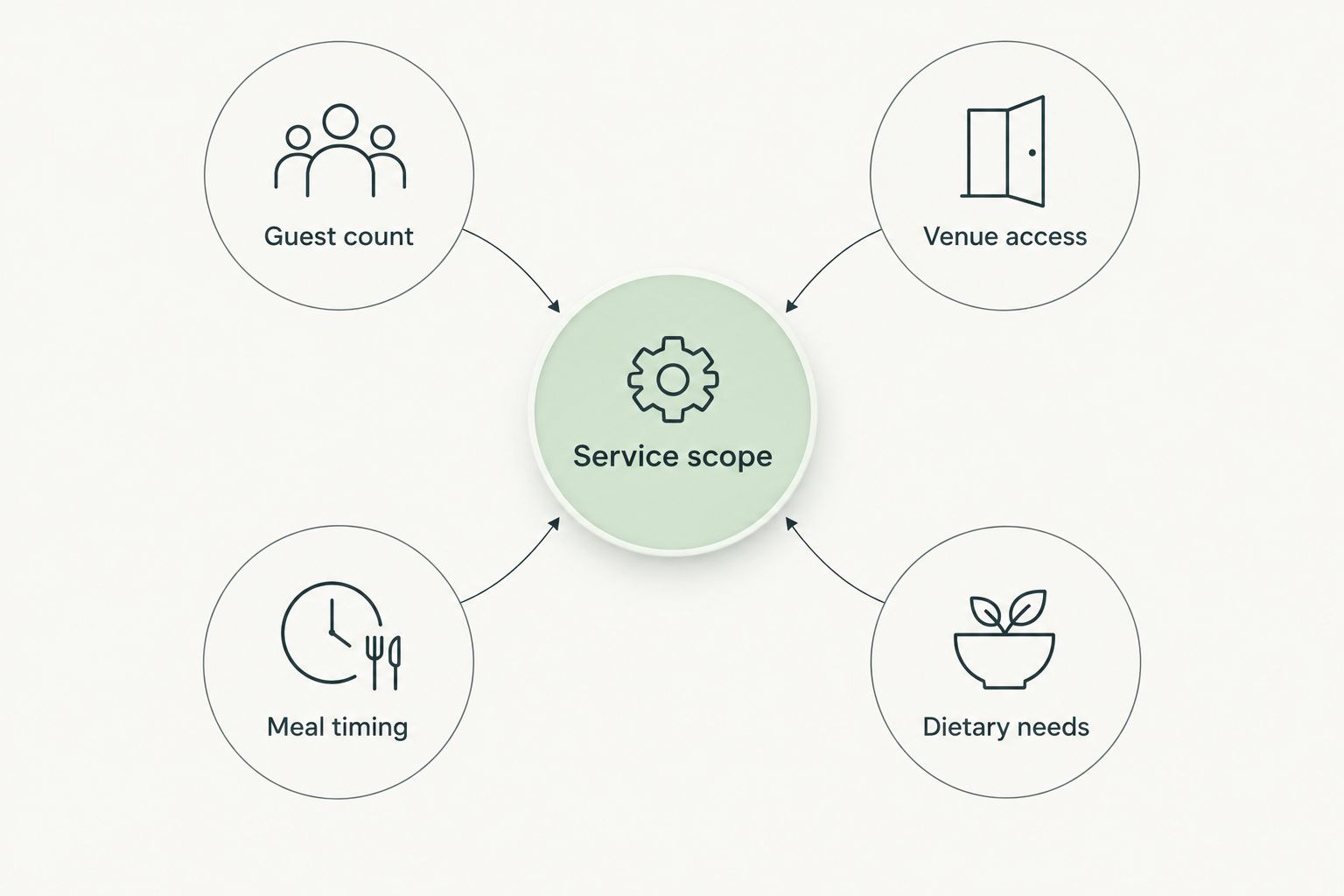
Organize your brief under these headings:
- Guest count: expected attendance, confirmation status, and whether other event personnel need meals.
- Venue access: address, indoor or outdoor setting, preparation facilities, and loading restrictions.
- Meal timing: guest arrival, service window, presentations, and the venue’s clearing deadline.
- Dietary needs: known allergies, dietary preferences, and how remaining requirements will be collected.
- Service scope: preferred format, staffing expectations, equipment responsibilities, and cleanup needs.
Keep your preferred experience clear, too. “A seated dinner that allows uninterrupted client conversation” tells a caterer more than “something elegant.” Describe what you want guests to feel and do, then ask for a practical service proposal.
Before approving a 2026 proposal, check that the written scope answers your brief. If the format or menu changes during planning, ask for the revised responsibilities to be reflected in the agreement as well.
How do you coordinate dietary needs for 100 guests?
For 100 guests, collect dietary information through a consistent process rather than scattered messages. Ask attendees to distinguish an allergy from a preference, then share the information with the caterer before menu approval.
Do not promise an allergen-free meal on the provider’s behalf. Ask about ingredient review, preparation practices, cross-contact precautions, labeling, and how the correct meal reaches the correct person.
The guide to planning a corporate event menu for dietary restrictions addresses a planning task that should sit alongside attendance and venue coordination—not after the menu is finalized.
Assign someone on your event team to communicate updates. Agree on how late changes will be assessed, and confirm what the caterer can accommodate before responding to the guest.
How should you check service capacity before booking?
Ask the caterer to describe the event from arrival through departure. You are looking for a workable sequence: access to the building, preparation, setup, meal service, clearing, and removal of equipment.
A discussion of corporate catering options by group size should connect attendance with service format and venue logistics, rather than treating headcount as the only booking criterion. For your Dallas or Fort Worth event, the provider still needs to confirm the plan for your specific location.
Use practical questions:
- Who coordinates with the venue before event day?
- How will food move from preparation space to the serving area?
- What happens if attendees arrive together rather than gradually?
- Who manages replenishment, dietary meals, and clearing?
- Which responsibilities remain with your team or the venue?
A clear explanation of service is more useful than a broad assurance that a group is manageable. Ask for unresolved items to be settled before you approve the scope.
Is Gabbeys a fit for a large corporate event?
Gabbeys corporate event catering is best for hosts seeking personalized menus and attentive service. Those client-confirmed priorities give you a useful starting point for discussing a polished company gathering.
The benefit is a service conversation centered on your occasion rather than an assumed menu. The limitation is that a general description does not establish capacity, venue suitability, inclusions, or a booking commitment for 100 guests; those details require confirmation.
Gabbeys also provides recurring in-home meal prep, private dinners and parties, and wedding services. Keep your corporate inquiry specific, however, so the response addresses this event’s attendance, schedule, and hospitality needs.
Request your corporate catering proposal
Share your Dallas or Fort Worth venue, guest count, date, and preferred dining experience.
Can all 100 guests eat at the same time?
100 guests can share a meal period when the service plan supports it. Confirm the available serving window, how guests receive food, and how the room layout supports that sequence.
Do not treat the scheduled lunch break as proof that every proposed format fits. Ask the caterer to explain the timing against your actual agenda.
Does the venue need a full kitchen?
A full kitchen is not a universal requirement for corporate catering. The necessary facilities depend on the menu and where preparation, holding, and finishing take place.
Give the caterer the venue’s actual facilities and restrictions. Ask for confirmation that the proposed menu works within them before making commitments to guests.
FAQ
Can corporate event catering handle more than 100 guests?
Corporate event catering can serve more than 100 guests when the provider confirms a suitable menu, staffing plan, venue arrangement, and service schedule. Obtain confirmation for your specific event rather than assuming every caterer supports the same capacity.
What is the best catering format for a company event with 100 guests?
The best format for 100 guests depends on the agenda and venue. Buffet service suits flexible gatherings, plated service suits seated hospitality, and stations suit events built around movement and conversation.
How much does corporate catering for 100 guests cost?
Corporate catering for 100 guests requires a personalized quote based on the menu, service format, venue, duration, and agreed responsibilities. Ask the provider to identify staffing, equipment, setup, and cleanup in the scope.
Can a caterer accommodate allergies at a large corporate event?
Allergy accommodation requires direct confirmation from the caterer. Share each requirement and ask about ingredients, preparation practices, cross-contact precautions, and meal identification before making assurances to attendees.
What should I include in a Dallas or Fort Worth catering inquiry?
Include the date, venue address, expected guest count, meal schedule, preferred format, and known dietary needs. Describe the atmosphere you want and ask which service responsibilities the proposal covers.
Does Gabbeys provide corporate event catering?
Gabbeys provides corporate event catering with personalized menus and attentive service. Confirm your event date, location, guest count, requested format, and scope directly before booking.
Should I confirm the venue before choosing a corporate catering menu?
Confirm the venue’s facilities and restrictions before approving the menu. Preparation space, access, equipment, and service rules need to support the proposed dining experience.
One last thing
For your 2026 event, ask this before signing: “What will guests experience between entering the room and receiving their meal?” The answer brings timing, layout, staffing, and hospitality into the same conversation.
A thoughtful menu matters. So does making the meal feel comfortable, well-paced, and connected to the occasion.