Yes, corporate event catering can be held at an outdoor venue when the venue permits it and the catering plan provides safe food handling, suitable service facilities, and a weather backup. For a Dallas or Fort Worth gathering, confirm those conditions before choosing the menu so your guests can enjoy the occasion without avoidable interruptions.
- Corporate event catering outdoor venue planning starts with venue approval, food safety, and a workable weather backup.
- Gabbeys offers corporate catering with personalized menus and attentive service; request a quote for your specific setting.
- Choose the service format after confirming power, water, kitchen access, and guest movement.
- An outdoor dining area does not automatically provide a suitable outdoor food preparation area.
Can corporate event catering be held at an outdoor venue?
An outdoor venue works for corporate catering when the dining space and the food-service operation are both accounted for. A courtyard with attractive seating still needs a practical plan for receiving, holding, serving, and clearing food.
Start with these checks before committing to the setting. Then compare catering styles for a Dallas corporate event against the facilities your venue actually provides.
- Get venue approval. Ask whether outside caterers are permitted and whether the venue requires insurance documentation, approved equipment, or designated preparation areas. Confirm who handles any applicable health or fire approvals.
- Identify the working area. Establish where food arrives, where staff prepare or finish dishes, and where food stays safely hot or cold. Keep that area separate from guest circulation.
- Check utilities. Confirm usable power, potable water, handwashing facilities, and waste disposal. Ask the caterer to assess whether the available facilities support the proposed menu.
- Choose a service format. Match the format to your agenda, seating, and guest movement. A networking reception and a seated client dinner need different arrangements.
- Approve the weather alternative. Identify a genuinely usable alternative and decide who authorizes the move. Include food storage, staff access, and service timing in that decision.
A written agreement should make responsibilities clear. Do not leave equipment, cleanup, or relocation arrangements to assumptions between the venue and caterer.
Why this matters for Dallas–Fort Worth hosts
An outdoor company gathering should feel welcoming, not improvised. Guests notice whether they can find refreshments, hear a presentation, and move comfortably between conversation and dining.
For your 2026 event brief, describe the experience first: an employee appreciation lunch, a client reception, or an executive dinner. That purpose helps determine whether guests need open networking space, assigned seating, or service coordinated around speeches.
Gabbeys corporate catering is best for hosts who want personalized menus and attentive service. Outdoor feasibility still depends on the venue, event requirements, and the arrangements confirmed for your booking. Personalization is a reason to inquire, not a substitute for a site-specific plan.
Which outdoor catering format fits your event?
Choose the format around the way you want people to spend their time. The table below compares planning options, not confirmed packages or inclusions from any caterer.
| Format | Best for | Main advantage | Main constraint |
|---|---|---|---|
| Plated service | Seated client dinners and presentations | Guests remain seated while dishes arrive | Requires coordinated service routes and course timing |
| Staffed buffet | Team meals with a defined dining break | Guests can see choices before selecting food | Queues and safe food holding need dedicated space |
| Attended stations | Receptions with separate gathering areas | Food service can be distributed around the venue | Each station needs suitable equipment and staff access |
| Passed reception | Conversation-led networking | Guests can continue circulating | Guests still need accessible ways to eat, rest, and request dietary alternatives |
No format removes the need for temperature control or protected food handling. An elegant presentation must also work behind the scenes.
Plated service: best for seated client dinners
Plated service suits an outdoor dinner where conversation and a shared schedule matter. It gives the meal a clear place in the evening rather than asking guests to leave their tables during a presentation.
The constraint is coordination. Confirm the route from preparation to tables, how staff will work around chairs, and what happens if remarks run longer than planned. Choose plated service when your seating plan and agenda are settled.
Buffets and stations: best for flexible guest choice
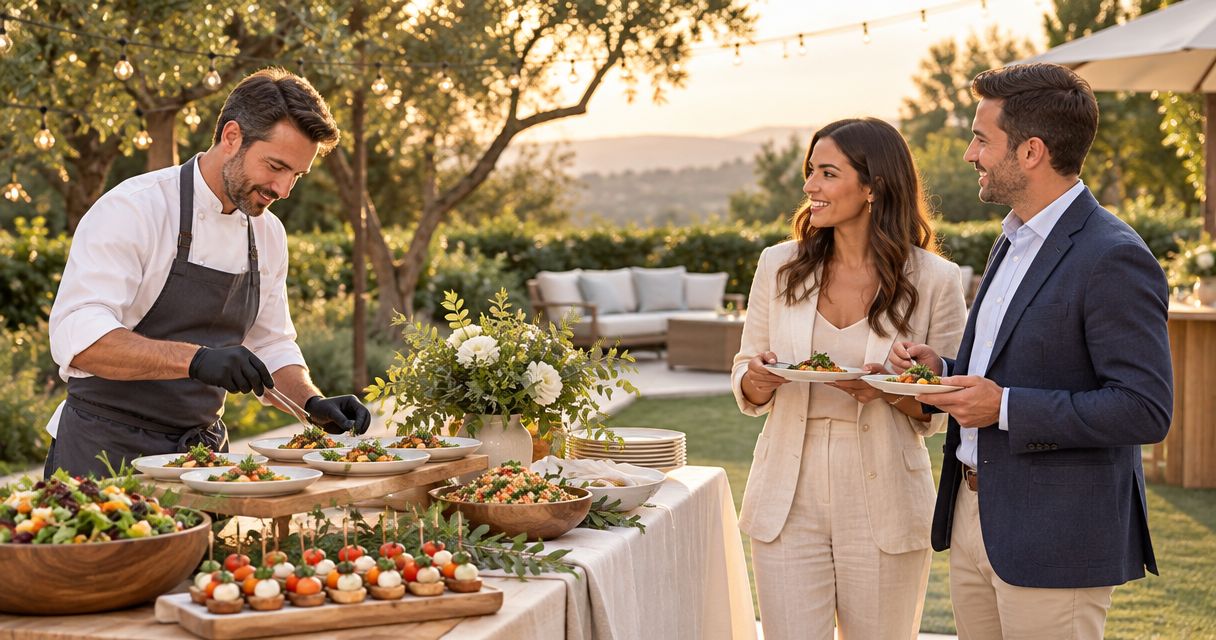
A staffed buffet or attended stations can support a company gathering where guests choose from an agreed menu. Placement matters: food queues should not block entrances, accessible routes, or the path to refreshments.
The trade-off is infrastructure. Multiple serving points create multiple places to manage utensils, replenishment, and holding conditions. Choose these formats when the site supports the service footprint, not simply because the lawn looks spacious.
Passed receptions: best for conversation-led gatherings
Passed food keeps the focus on introductions and conversation. It fits an event built around mingling rather than a formal seated meal.
The limitation is guest comfort. Provide seating opportunities, explain how dietary requests will be handled, and decide whether the menu is intended as refreshments or a full meal. Choose a passed reception when the invitation clearly sets that expectation.
What does an outdoor venue need for catering?
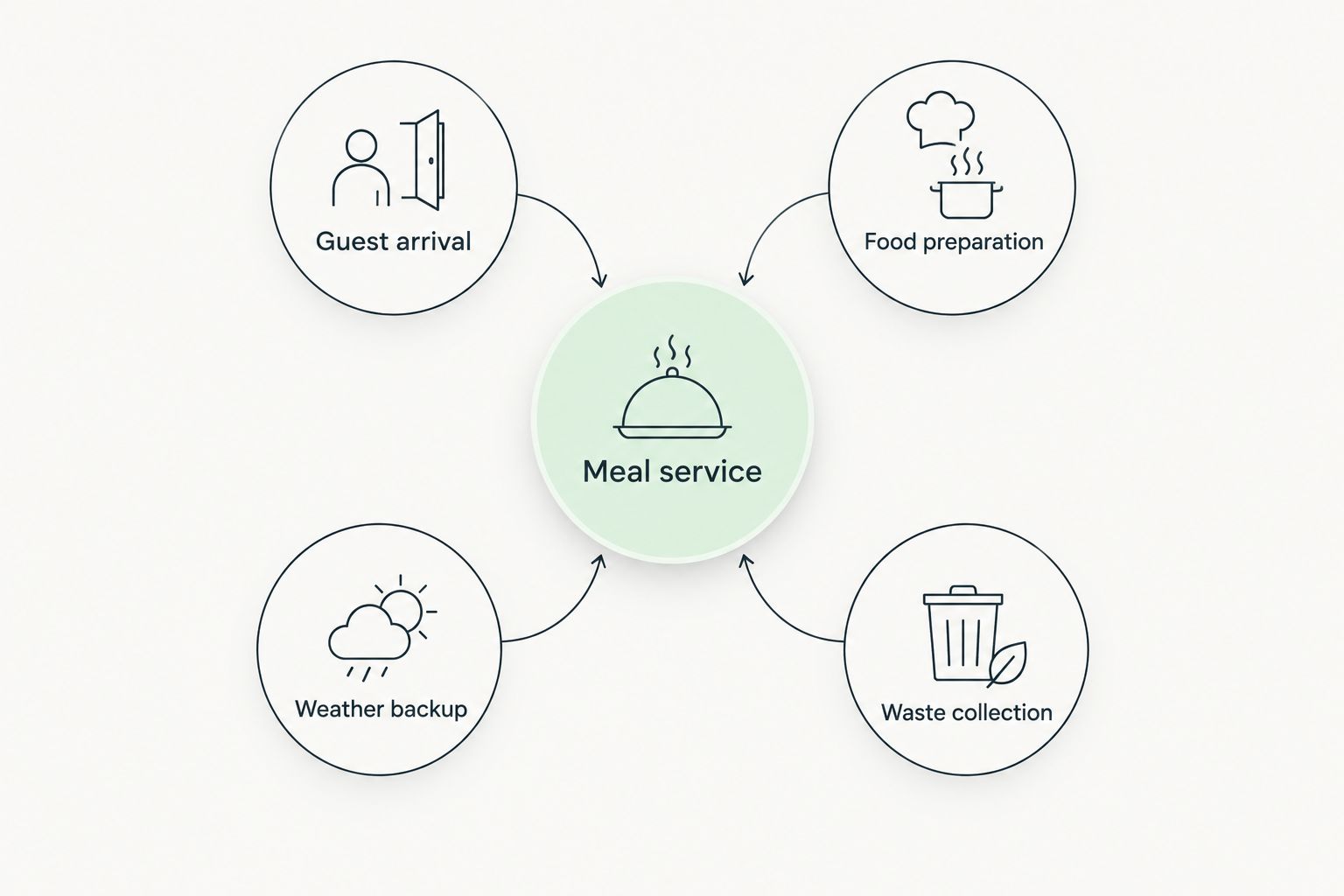
Think of the venue as connected working areas, not just a dining backdrop. Guests need a comfortable arrival and seating arrangement; the catering team needs a protected route through preparation, service, and clearing.
Use these areas as the basis for your 2026 site discussion:
- Guest arrival: Identify entrances, accessible routes, and the path to seating.
- Food preparation: Locate approved working space away from guest traffic.
- Meal service: Position tables or stations so staff can replenish food safely.
- Weather backup: Identify the alternative space and how the event reaches it.
- Waste collection: Plan clearing and disposal without routing waste through food preparation.
Ask the venue to show the actual service route. Steps, soft ground, narrow gates, and distant unloading areas belong in the conversation before equipment and staffing are agreed.
Also distinguish guest shelter from catering shelter. Cover over the dining tables does not establish that food preparation, electrical equipment, or staff working areas are protected.
How do you keep catered food safe outdoors?
Keep perishable food under controlled conditions rather than treating the serving table as storage. Outdoor presentation does not change the need for safe temperatures, clean utensils, protected ingredients, and appropriate handwashing.
For your 2026 planning checklist, USDA consumer guidance provides useful reference points for perishable food: keep cold food at 40°F or below and hot food at 140°F or above. These are consumer holding guidelines, not cooking temperatures or a substitute for the rules governing a permitted catering operation.
USDA guidance also says to refrigerate perishable food within 2 hours, or within 1 hour when the temperature is above 90°F. Ask the caterer to explain the applicable commercial food-safety procedures rather than attempting to manage the event around a household time limit.
Give particular attention to these details:
- Who monitors holding conditions during service?
- How are dishes replenished without leaving reserve food exposed?
- Where can staff wash their hands?
- How are allergens identified and cross-contact risks addressed?
- Who decides whether leftovers can be retained safely?
Do not promise guests that every dietary request can be accommodated. Share specific allergies and restrictions early, then obtain a clear response about what the preparation environment can support.
Why outdoor corporate catering requirements vary
Outdoor corporate catering does not have a single equipment or staffing plan. The right arrangement follows the site and the experience you want to create.
These factors belong in a personalized quote request:
- Guest count: Attendance affects food quantities, seating, service flow, and clearing requirements.
- Menu and dietary needs: Dishes differ in preparation, holding, and finishing requirements. Dietary requests need an agreed approach.
- Service format: A seated dinner, staffed buffet, and circulating reception create different staffing and equipment needs.
- Venue facilities: Kitchen access, utilities, unloading, and approved working areas determine what must be arranged separately.
- Event schedule: Arrival, speeches, meal service, and departure shape how the team works throughout the gathering.
- Weather arrangements: A protected alternative, relocation procedures, and equipment changes belong in the agreed scope.
Compare complete written scopes, not menu descriptions alone. Ask which services and equipment are included, which require separate arrangements, and who coordinates each supplier. Request a personalized quote instead of relying on an unconfirmed outdoor surcharge or package assumption.
What happens if the weather changes?
A weather plan needs a location, a decision-maker, and a communication process. “We will move inside” is incomplete if the indoor room cannot accommodate the agreed dining arrangement or food-service setup.
For a 2026 Dallas–Fort Worth gathering, ask the venue and caterer to agree on the following before event day:
- The alternative location and its permitted use.
- The conditions that trigger a change.
- Who makes the final decision and informs suppliers.
- How guests receive updated arrival or seating instructions.
- How food, equipment, and staff move without unsafe disruption.
A tent is not a complete severe-weather plan. Ask the venue about appropriate shelter and follow local emergency instructions. Wind, lightning, heat, and rain require more than protecting table settings.
Can the food be prepared indoors and served outside?
Yes, food can be prepared indoors and served outside when transport, holding, and service arrangements meet applicable requirements. This separates the guest experience from the preparation space without removing the need for safe handling.
Confirm the distance and route between the kitchen and dining area. Ask how dishes remain at the required temperature and how staff communicate when a speech, presentation, or guest arrival changes the schedule.
Do you need permission to cater at an outdoor venue?
Yes, obtain the venue's approval before arranging outside catering. Any additional permit, health, fire, or equipment requirements depend on the location and proposed activities.
Ask the venue and caterer to identify the responsible authority and confirm who obtains required approvals. Do not assume that renting an outdoor space authorizes cooking equipment, open flames, or every form of food service.
What should you send with a booking inquiry?
A useful inquiry describes the occasion and the site, not just the desired menu. For a 2026 event, send the date, Dallas or Fort Worth location, expected attendance, event purpose, and proposed service schedule.
Include the venue name, indoor kitchen access, available utilities, dietary needs, and weather alternative. If the venue has not yet been chosen, say so and ask which catering requirements should guide the selection.
Gabbeys offers corporate catering alongside private dinners, parties, weddings, and recurring in-home meal prep. For this inquiry, keep the focus on the corporate occasion so the discussion can address your guests, setting, personalized menu, and service expectations without confusion between services.
Plan your outdoor corporate gathering
Share your venue, guest count, dietary needs, and event schedule to request a personalized quote.
FAQ
Can corporate event catering be held outside without a kitchen?
An outdoor event without an on-site kitchen requires a caterer-approved plan for preparation, transport, holding, handwashing, and service. Confirm the necessary facilities and any applicable approvals before booking.
Is a buffet better than a plated meal for an outdoor corporate event?
A buffet suits guest choice, while plated service suits seated meals with a coordinated agenda. Choose according to your venue layout and event purpose; both need safe food holding and a practical staff route.
How long can catered food sit outside?
USDA consumer guidance limits unrefrigerated perishable food to 2 hours, or 1 hour when temperatures exceed 90°F. Your caterer must follow the applicable commercial requirements and maintain appropriate temperature control during service.
Does an outdoor corporate event need a rain plan?
An outdoor corporate event needs a workable weather alternative, not just a promise to improvise. Confirm the alternative space, decision-maker, supplier communication, and guest instructions in advance.
Can an outdoor catering menu accommodate food allergies?
Food-allergy accommodation must be confirmed with the caterer for the specific menu and preparation environment. Provide the exact restrictions early and ask how identification, utensils, and cross-contact risks will be managed.
Does Gabbeys offer corporate event catering?
Gabbeys offers corporate event catering with personalized menus and attentive service. Submit your location, venue details, attendance, and schedule to discuss the requirements for an outdoor gathering.
How do I get a quote for outdoor corporate catering?
Request a personalized quote with your date, location, guest count, menu preferences, service format, and venue facilities. Include weather arrangements and dietary needs so the proposed scope addresses the actual event.
One last thing
Walk the route the food will take, not only the route your guests will take. An attractive terrace can still have awkward kitchen access, an exposed service path, or an unloading area that conflicts with arrivals.
Before approving the final layout, ask the venue and caterer to review that route together. It is a specific, practical way to protect the attentive experience you want guests to remember.